Ingi Innrisser and Oddr Omrisser

Two Nordic petroglyph artists who worked on their own, and often together

Allan Krill, Professor of Geology
Trondheim, Norway

In June 2021, while looking at the Alta petroglyphs (helleristninger) with my geology students, I realized that those engravings could not have been pecked with Stone Age tools. Rocks are brittle, and stone points shatter when struck. We can see that the pecking tool was as sharp as a nail and could be accurately positioned and hammered. The point kept its shape without breaking, strike after strike. An iron nail would be the ideal tool. I hypothesized that the Alta petroglyphs were pecked with boat nails in the Iron Age, not with pointed stones in the Stone Age.

These peck marks at Alta could not have been made with stone points.

Left: Longship with animal-head prow and a crew of 15 (or 30) men.
  Center: Deer.
    Right: 'Bronze Age'-style boat, and 10,000 year old glacial striations.


Some of the rock art images are Viking-style longships with animal-head prows and large crews. Such boats are for long-distance travel, not for fishing. It would probably take about two weeks for a crew to paddle to Alta from southwestern Norway. There would always be a hammer and spare nails on a longship for necessary repairs. A petroglyph artist who was a strong paddler would be welcome to join such trips.
       People with longships would not spend winters in arctic Alta, where the sun sets on November 24th and doesn't rise again until January 16th. They would probably visit Alta in the midnight-sun season, like I do. Some images among Alta petroglyphs suggest that S‡mi people herded reindeer in corrals, and the visitors were obtaining reindeer skins from them.

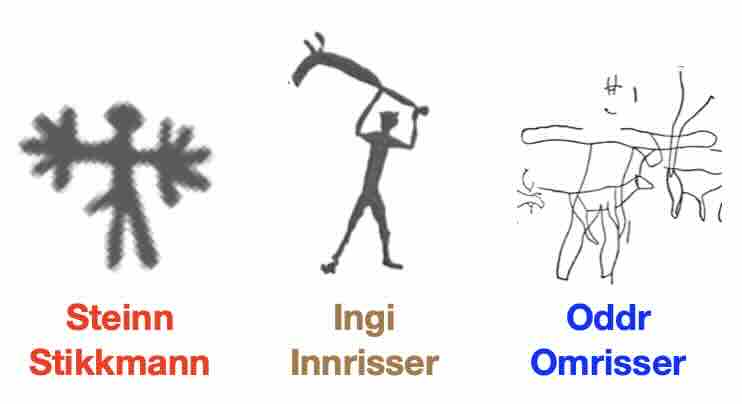
I have studied photographs and tracings of Scandinavian petroglyphs to recognize individual artists by their motifs, styles, and quirks. I now think that only three artists Ñwhom I call Steinn Stikkmann, Ingi Innrisser, and Oddr OmrisserÑ made nearly all the petroglyphs in Norway, Sweden, and Denmark. Stikkmann also made most of the petroglyphs in Valcamonica, Italy. There are no pecked petroglyphs in Finland, and none in large parts of Sweden, or in Aust-Agder Norway. In my paradigm, that is because none of the three petroglyph artists visited those places.ÊAnother artist in Russia, just east of Finland, used the same technique to engrave animal-head longships and scenes of whaling, hunting, and skiing.


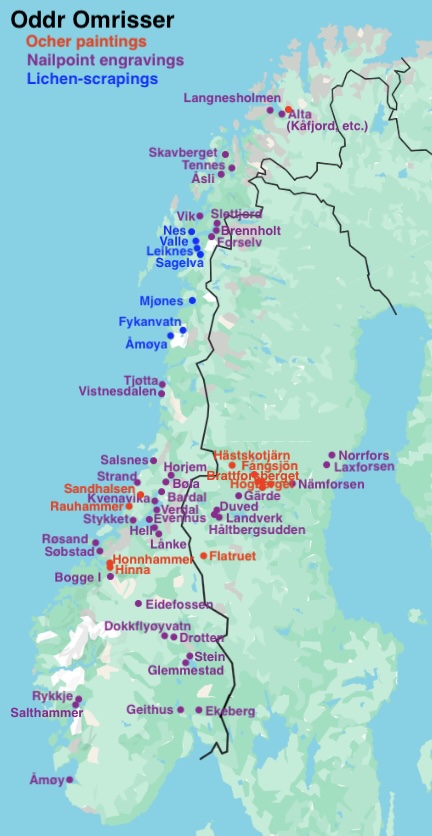
The two maps below show the locations more accurately. There are no 'Bronze Age' petroglyphs in central Norway and northern Sweden. There are no 'Stone Age' petroglyphs in southern and central Sweden. If the petroglyphs were made by ancient cultures, as archaeologists have maintained, I think they would not be absent in populated areas. I contend that Stikkmann made all the supposed 'Bronze Age' petroglyphs, except for a few made by Omrisser at Alta, Bogge, NŠmforsen, and Stavanger. Innrisser and Omrisser made all the supposed 'Stone Age' petroglyphs, except for a few made by Stikkmann at Sporanes.


I hypothesize that Steinn Stikkmann invented the nailpoint technique, and Innrisser and Omrisser got the idea from him. There are runes at eight of Stikkmann's sites: at Stuberg, Ytter¿ya, Tessem, KŒrstad, Myklestad-Tysnes, Askum, (Tanum 441?), Herrestad, and Himmelstalund. Except for KŒrstad, the runes are undeciphered, and some may have been meaningless. But they show characters of the Elder Futhark alphabet, which was in use about 400 CE. The runes give us the age of Stikkmann's petroglyphs. He also engraved a swastika Ñan Iron Age symbolÑ at Stuberg, Bj¿rngŒrd, Herdlev¾r, Inder¿ya, KŒrstad, Tossene, Svarteborg, and Askum. The two swastikas at Askum were his own design, known in Italy as Camunian roses.
       All three artists showed longships with animal-head prows, which were probably precursors of Viking dragon-head prows. Captains in some of Stikkmann's boats are wearing Viking-style helmets with horns. The petroglyphs were surely made before 800 CE, because Viking longships had sails by then. I think that Stikkmann lived about year 400 and Innrisser and Omrisser lived sometime between 400 and 600 CE. The Viking Age is said to have begun about 800 CE, but petroglyphs show that longship voyages were being taken 400 years earlier.


It is possible to consider the skills, motifs, and locations of the petroglyphs, and speculate about the artists' careers and travels. I explain my current interpretations here. In the blog links at the bottom of this page, I explain my hypotheses and discoveries over the past three years. I tend to write my interpretations with few hedge words, as if they are certain. But all my hypotheses are subject to change. (In art history, even some 'facts' are hypotheses.)


Ingi Innrisser had a childlike or primitive artistic style. He drew mostly deer Ñreindeer, red deer (hjort), or moose. They usually have small pointed heads, straight backs, and square rumps. He liked to decorate the bodies of deer with ribs or various patterns, including geometric designs.
       Innrisser's best work, and one of his last, was the large panel at KŒfjord near Alta. Part of that panel is shown below, in the tracing by Karin Tansem (2022). It shows a bear that has wandered into a corral of herded reindeer. Innrisser was documenting S‡mi culture, as we know it today. (I disagree with Knut Helskog's interpretation that the corrals in Alta are hunters' traps. I do not think that people would trap 40 reindeer in order to hunt them. The bear may be hunting.)


From analysis of Innrisser's motifs and styles, I am trying to follow his career. I hypothesize that his first work was at Vingen, where there are about two thousand nailpoint engravings. I think he made them all. They include his new-beginner attempts on loose rock slabs that he could hold on his lap while engraving. The page below, from Johannes B¿e (1932), shows some of these loose practice rocks. The scale bars for the tracings are 10-30 cm. Note the curious hook figures.


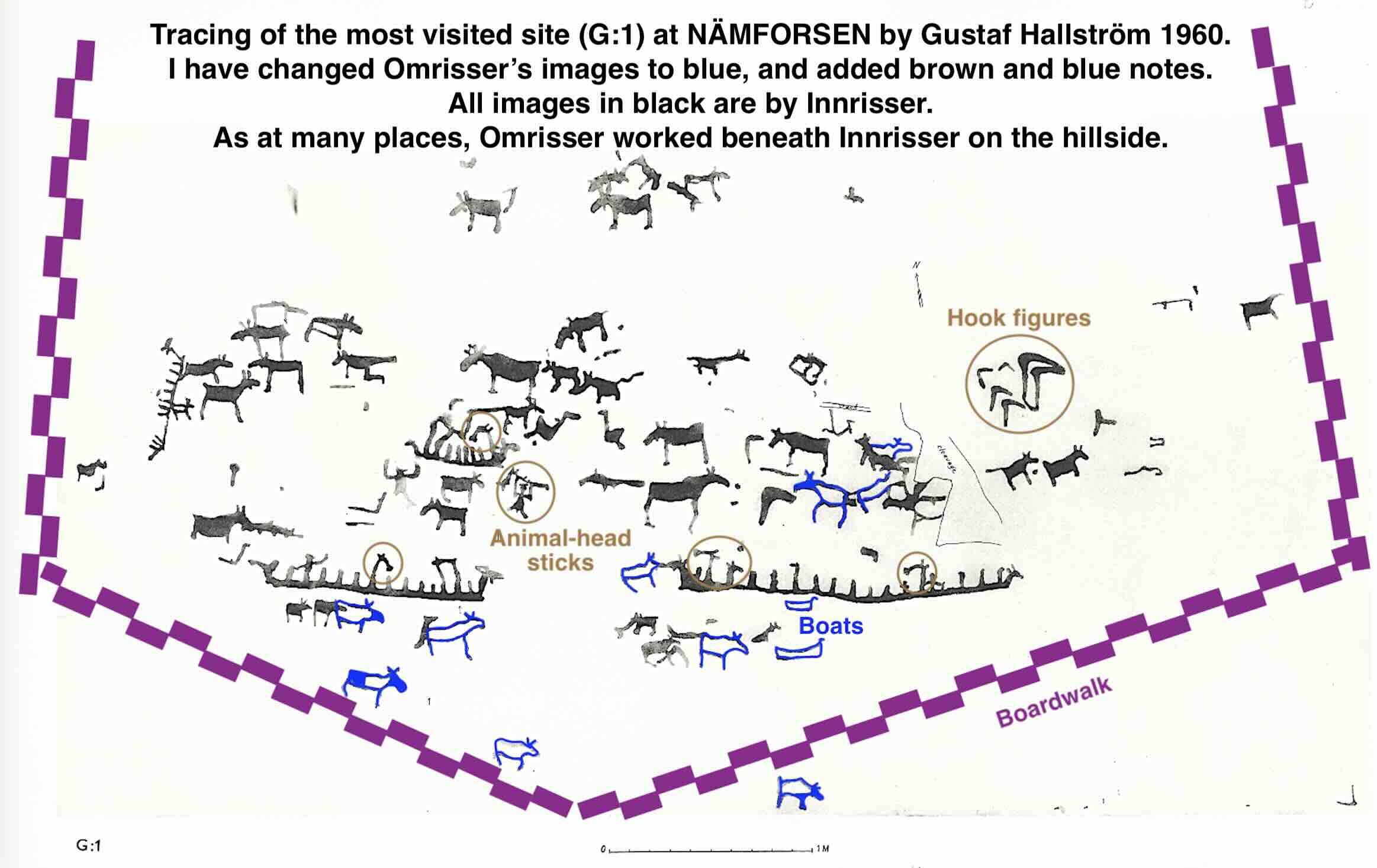
Innrisser engraved hundreds of hook figures. They comprise about 20% of his images at Vingen. I think he made the hook figures mostly to practice engraving. He also made a few hook figures at NŠmforsen. He made many at Alta (Hjemmeluft, KŒfjord, and Langnesholmen) such as in the KŒfjord figure below. At those sites we can see that the hook figures are animal-head sticks, often being held up high by men. A few at NŠmforsen are also held by men. Knowing that, we can notice that many of the crude hook figures at Vingen have animal ears (see B¿e's images in the page above.) Maybe Innrisser was depicting an animal-head walking stick that his father or grandfather had used.


Vingen is an isolated place, and there have never been more than a few houses there. I suspect that Innrisser actually lived in the Skatestraumen area, which was a population center in the Iron Age. It is about ten kilometers by rowboat from Vingen. Two-way tidal currents make the boat trip easy at certain times each day. Innrisser probably learned about nailpoint engravings from seeing Stikkmann's work. Then he probably visited Vingen daily for many weeks, making his own petroglyphs there.
       Innrisser took a long trip to northern Norway. I think he showed Oddr Omrisser how to engrave rocks at Tennes and Alta (Storsteinen and Amtmannsnes) during that trip. His next major work was probably at Ausevik near Vingen. His human figures at Vingen, Alta, and Ausevik are all wildly abstract. So are many of his deer at those places. He was experimenting with creative ways of drawing. In the picture below, Trond L¿d¿en (2012)) has put together 27 of the 61 humans at Vingen. No two human images are alike.


The tracing below by Anders Hagen (1970) of a panel at Ausevik shows one abstract human and about 13 deer. Innrisser also drew these images during his early experimental phase.


At most of Innrisser's sites (but not Vingen or Ausevik) he was together with Oddr Omrisser. Omrisser was a naturalist, and encouraged Innrisser to make his deer more anatomically correct Ñwith shoulder humps, muscular legs, and larger heads. At HoltŒs in Tr¿ndelag, I think Innrisser mocked Omrisser by adding silly-looking shoulder humps to the straight backs of his deer. See the tracing by Kristen M¿llenhus (1968) below.
 

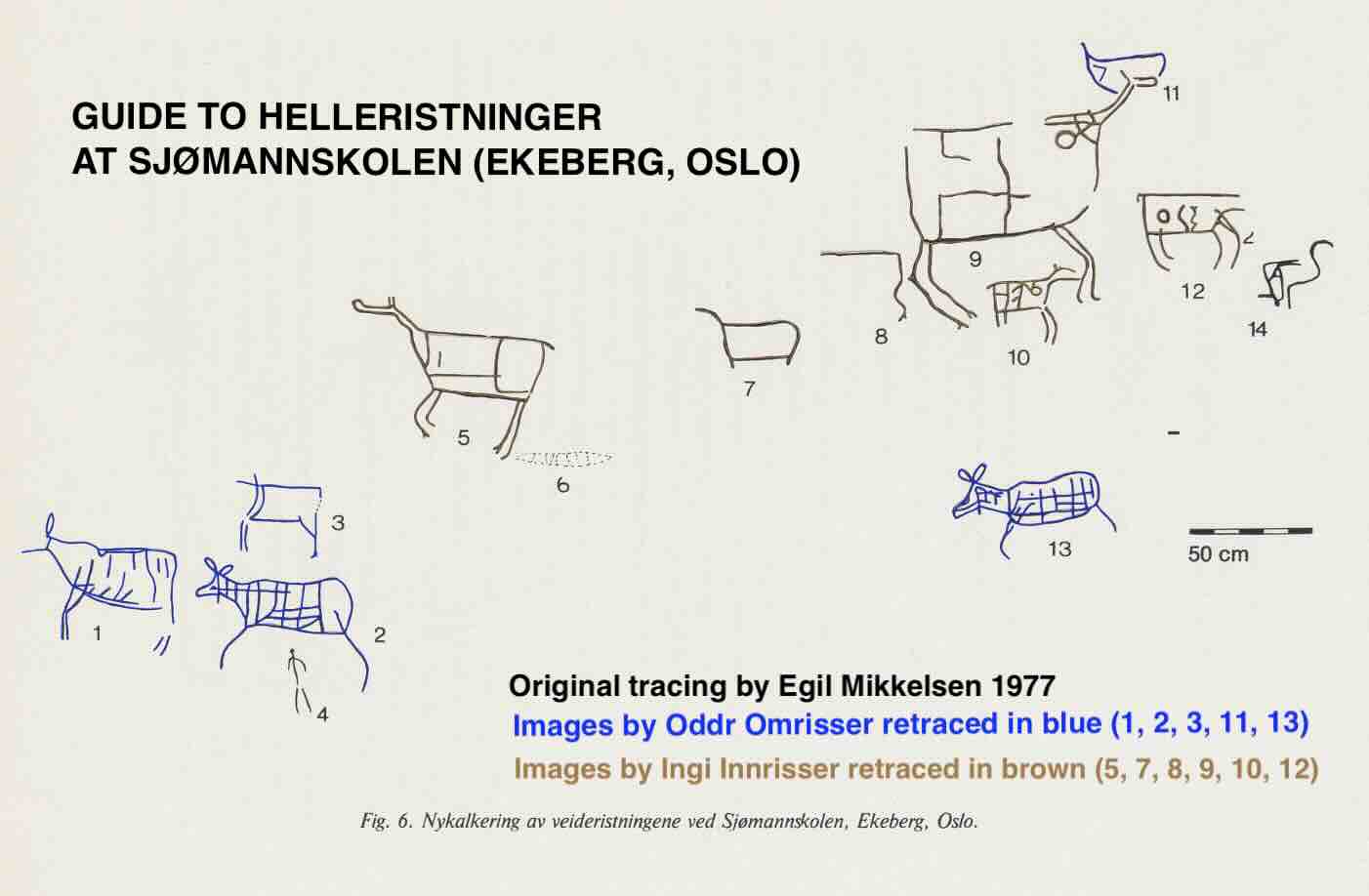
Innrisser and Omrisser took a long trip to eastern Norway (Oslo and Drammen), probably following one river valley south, and another back north. Innrisser added shoulder humps to his deer at some of those sites, such as at Skogerveien. See the tracing below by Egil Mikkelsen (1977).


Recognition of an artist's interests helps us to interpret obscure images. Innrisser liked snowshoes, and drew snowshoes or snowshoe tracks on many panels at Alta. So in the tracing at Skogerveien (above), the strange objects on the left are probably snowshoe tracks.
       Snowshoes in Alta do not necessarily depict winter scenes. Snowshoes can also be helpful in Alta in the spring, when the days never get dark, and when Innrisser's longship probably arrived. In the tracing below, I think the man standing in the animal-head boat is holding up a pair of snowshoes. (Innrisser showed the snowshoes held up high, so they would be noticed.) The objects below the boat may be an animal-head stick, and a bundle of reindeer skins to be taken by longship to southern Norway. I have colored two reindeer blue, because they were added by Omrisser, and not really part of Innrisser's panel.


Innrisser's panels at KŒfjord and Bergbukten (Alta) are especially important, because they are some of the earliest documentation of S‡mi culture. He showed reindeer in corrals, and S‡mi clothing items. The traditional clothing of S‡mi men in the Alta area includes a hat with points. The traditional clothing of S‡mi women includes a shawl with fringes. (Innrisser showed the boat, rope, and shawls up in the air to be easily seen.)


I currently think that Innrisser worked his sites in about this order (site locations on the top map): Vingen, Amtmannsnes (Alta), Storsteinen (Alta), Tennes, Skavberget, Ausevik, Surnadal, Salthammer, Bogge, Glšsa, HoltŒs, Bardal, Eidefossen, Dokkfl¿yvatn, Drotten, M¿llerstufossen, Stein, Glemmestad, Ekeberg, Skogerveien, skollen, Geithus, NŠmforsen, Langnesholmen, GŒshopen, Slettnes, Leirbukt, Gamnes, Apana GŒrd (Alta), Ole Pedersen (Alta), Bergheim (Alta), Bergbukten (Alta), KŒfjord.


Oddr Omrisser usually made outlines of his objects Ñof animals, of boats, of people, and even of the antlers of reindeer and the penises of men. He made images large and even life size when possible. He was a naturalist, and many of his animals are very lifelike. The species of his deer, birds, fish, and whales can often be identified.
       He had his quirks. He liked to draw a line for the mouth, but no eye. He often ignored the feet, leaving the legs unfinished or ending as points. He usually drew animals in profile, but not the ears, which often form a V. He showed only one foreleg and one hind leg on four-legged animals. (Innrisser and Stikkmann usually drew four legs.) He sometimes indicated a 'life-line' from the mouth to the stomach or heart. Innrisser did this also at some of his sites.
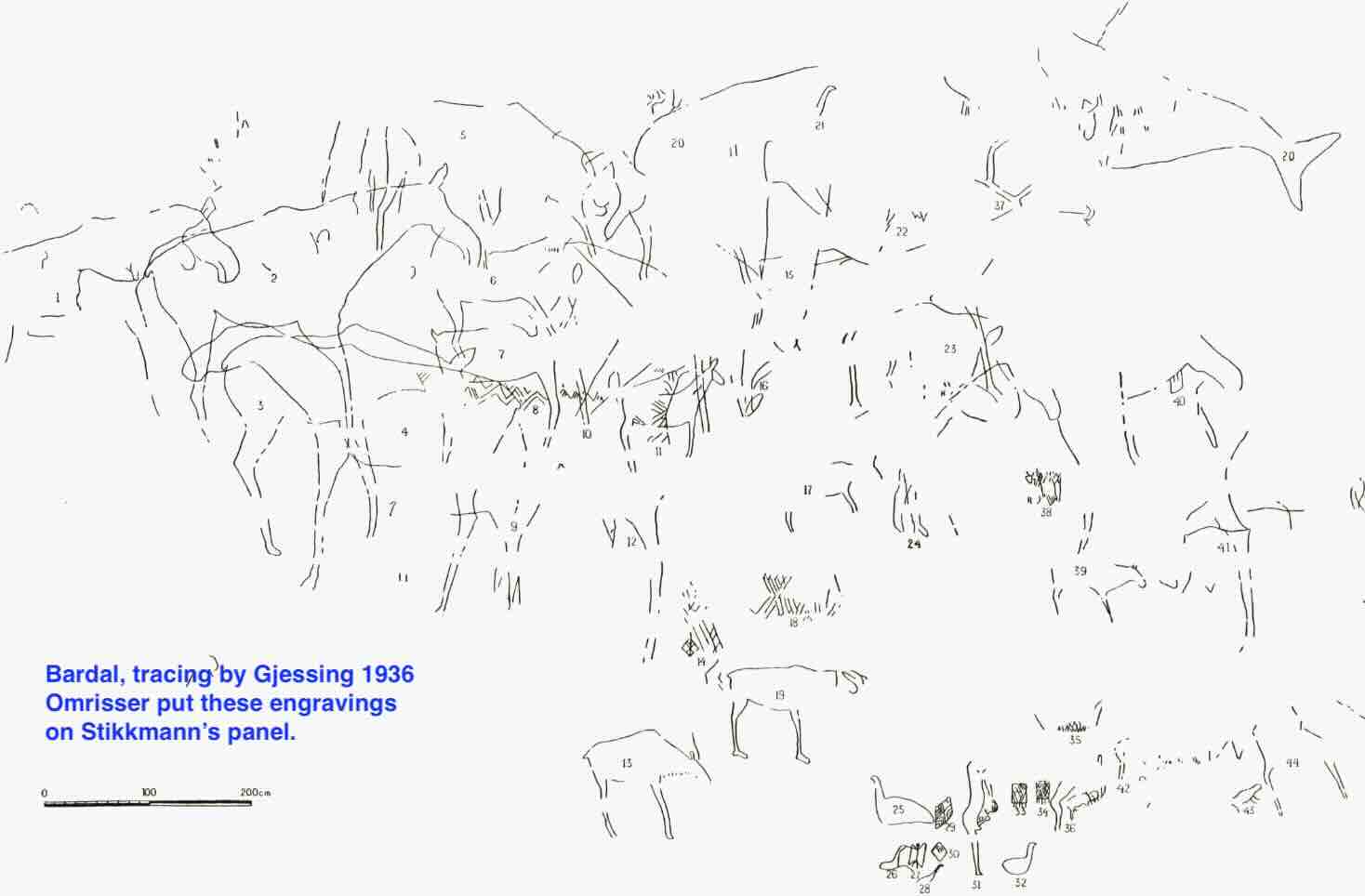
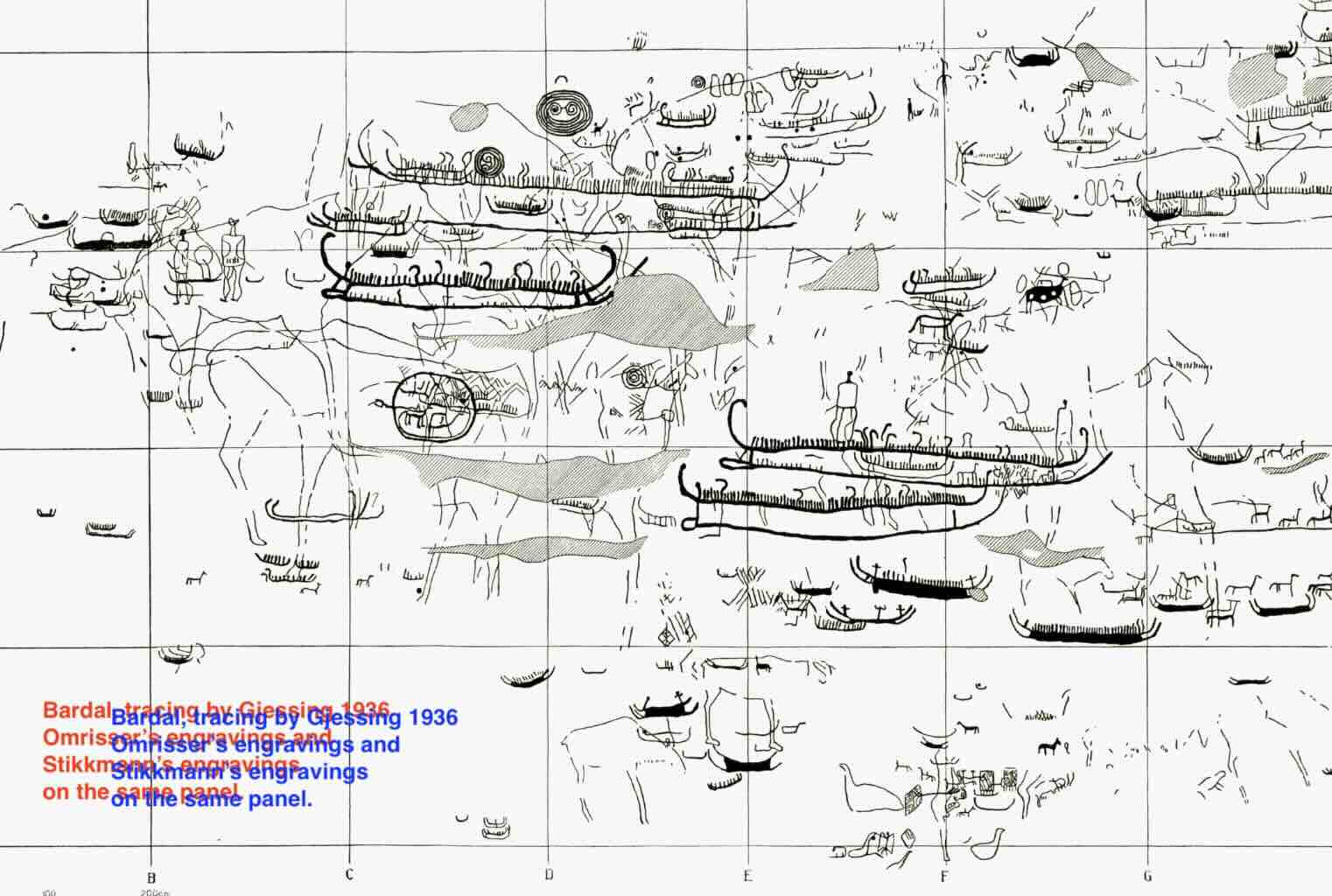
       Omrisser's images are typically overlapping and incomplete. I think he drew the complete animal, maybe with charcoal, and then engraved it only partially. We can deduce that from seeing incomplete images such as the 6-meter long whale in the tracing below. He had the habit of cluttering rock panels by drawing large and inappropriate images right on top of earlier carvings. He cluttered most of his own panels in that way, and defaced Stikkmann's panels at Bardal, Hammer IX, Revlan, and Stavanger, and Innrisser's panels at Alta, Bogge I, Ekeberg, KŒfjord, Langnesholmen, and NŠmforsen.


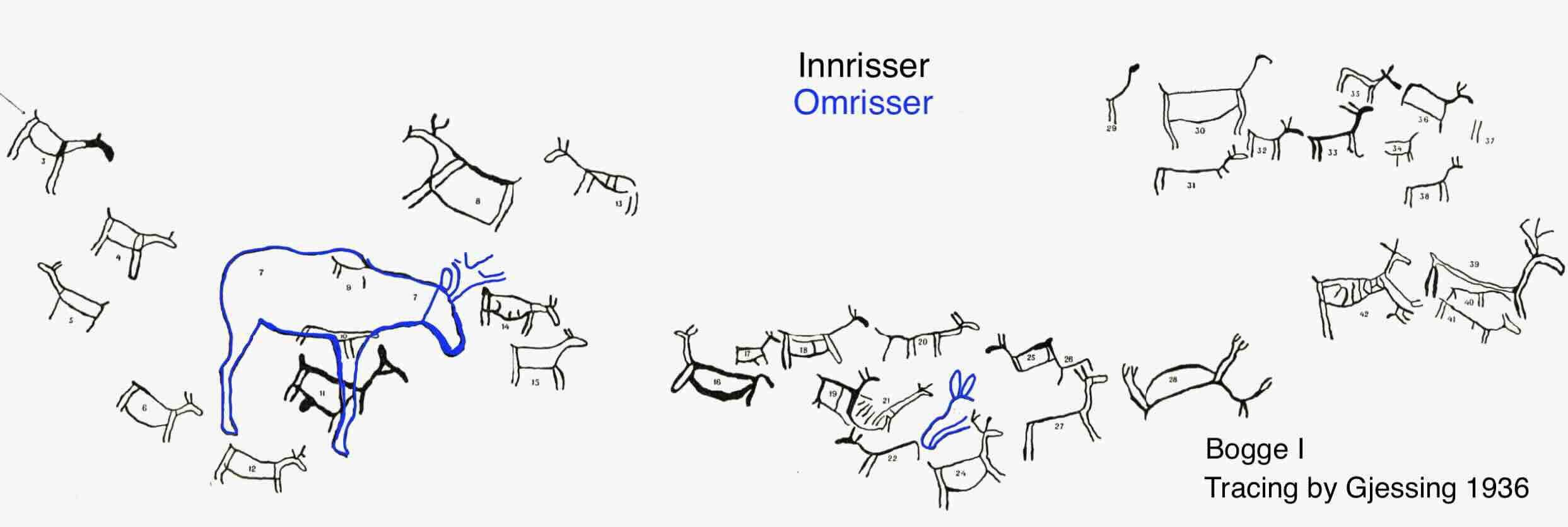
At Bogge I, Innrisser drew many deer, and then Omrisser put an oversize moose on top of some. He added a large deer-head there as well. Below is part of the tracing by Gutorm Gjessing (1936) of the defaced panel, where I have colored Omrisser's two images blue. I think Innrisser told Omrisser to get away and find another place to work. So Omrisser went down the hill and made two panels of his own (Bogge II, Bogge III). The same thing happened at HoltŒs I and II.


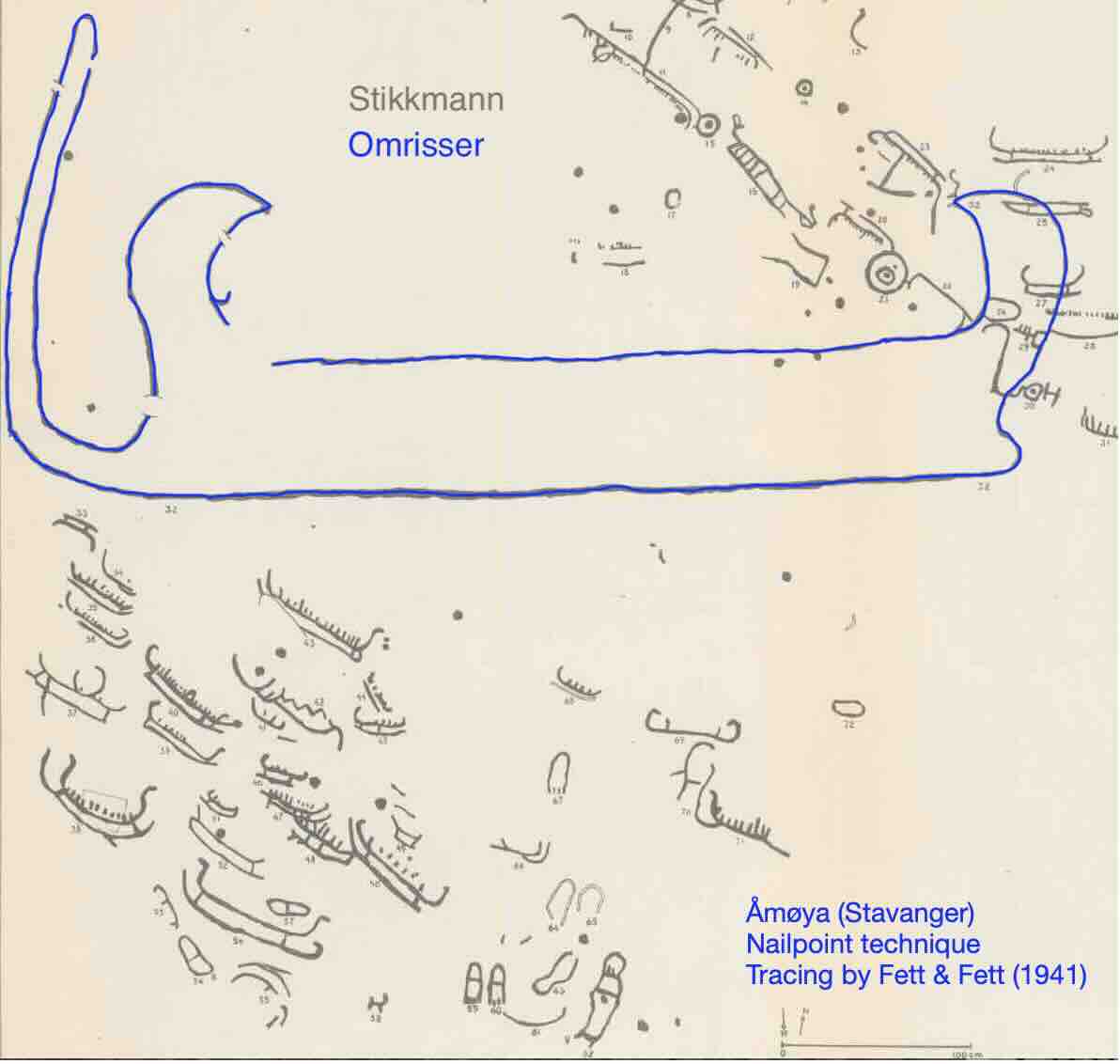
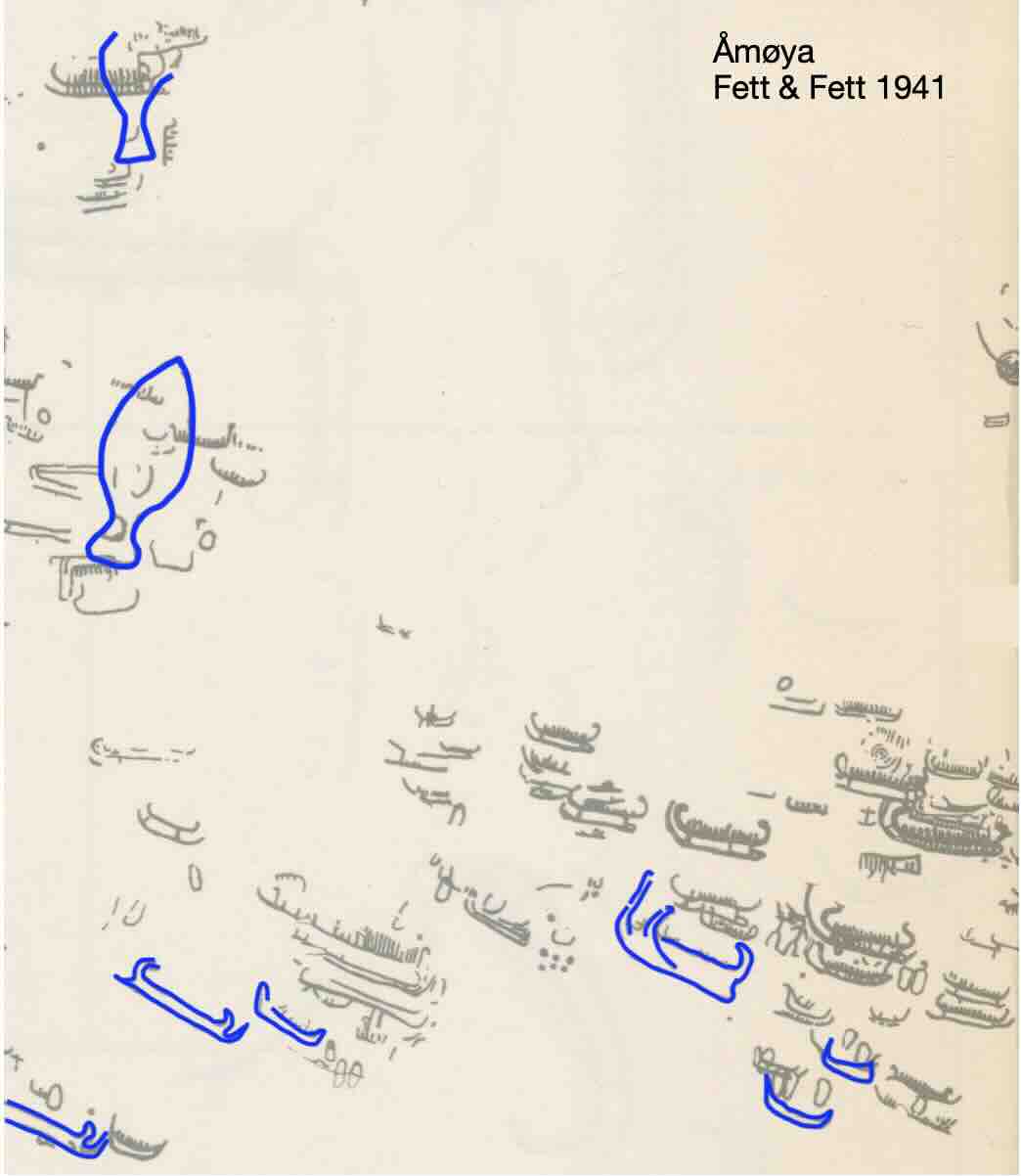
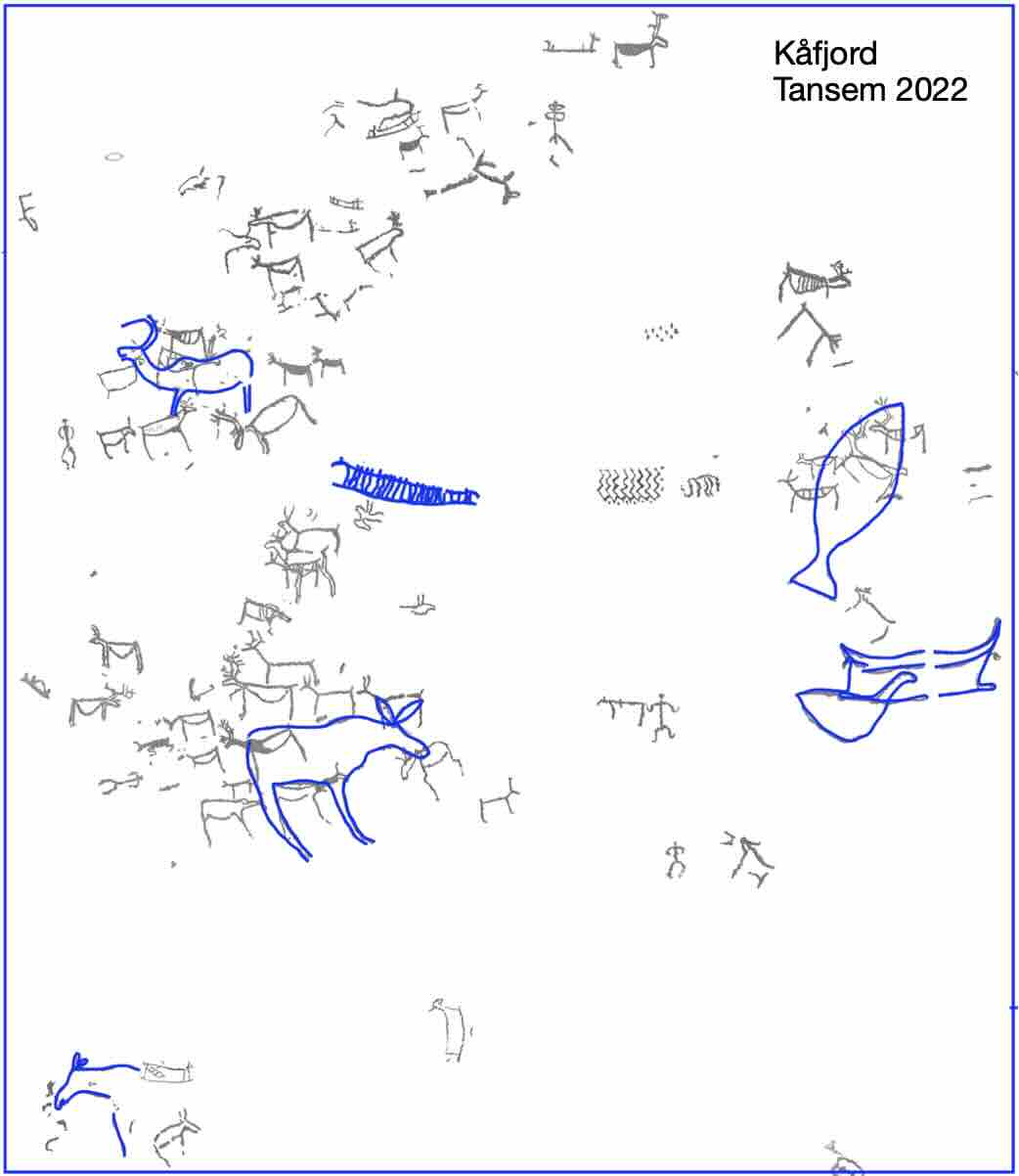
Below on the left is a tracing by Eva & Per Fett (1941) of a panel at Stavanger (m¿ya). It shows typical boats and shoe prints by Stikkmann. Omrisser defaced the panel by putting a few images (which I have changed to blue) on top of Stikkmann's images. Omrisser was copying Stikkmann's boats, to learn how to draw outlines of that boat type. He then made a 5.5 meter boat nearby. On the right is a tracing by Tansem (2022) of a panel at KŒfjord by Innrisser. Omrisser defaced the panel by putting several images on top of Innrisser's images. Note that Omrisser drew the same fish at Stavanger and KŒfjord, and the deer-head at KŒfjord is the same as at Bogge. He made that distinctive deer-head (often without the body of the deer) at many places in Norway and Sweden.
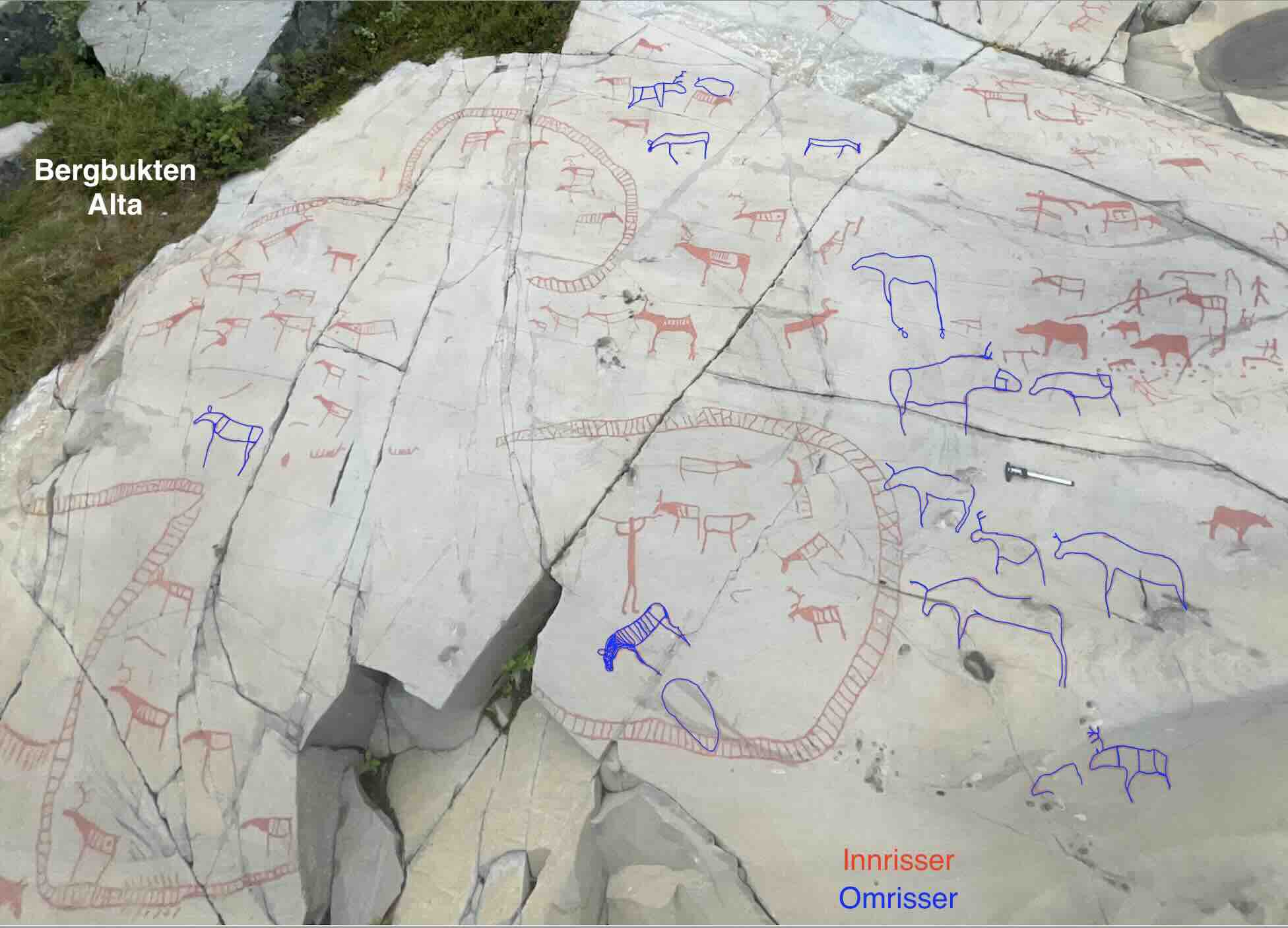
Some of Omrisser's added images almost fit in. At Bergbukten (Alta), Omrisser added reindeer (slightly oversized) to Innrisser's panel of reindeer and a corral. (Note also Innrisser's three bears making tracks as they head toward the corral.) All the images were painted red by Alta Museum, but I have changed Omrisser's images to blue in my photo (August 2025).

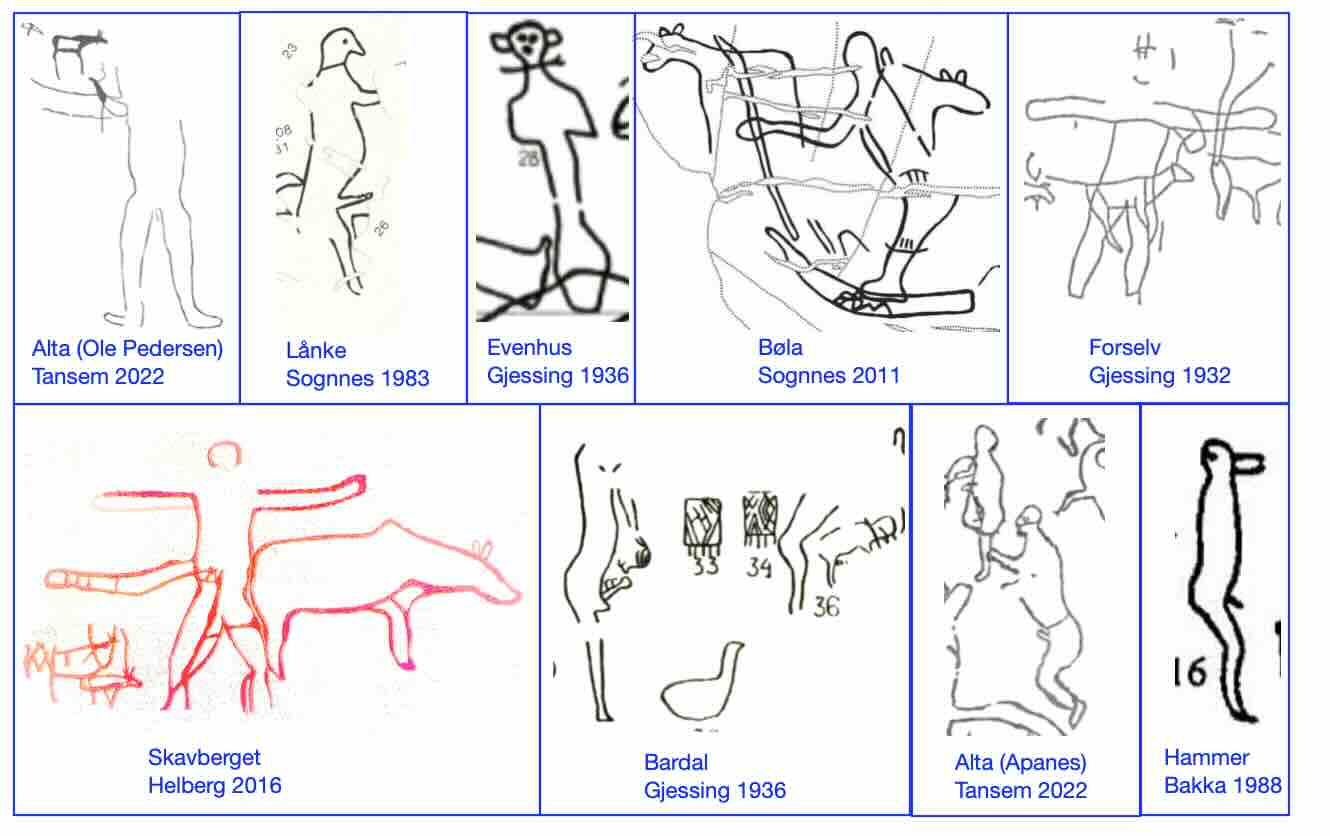
Omrisser usually made humans as small stick figures, like many of Innrisser's. But some of his humans are large and outlined, like his animals. Below is a collection of Omrisser's outlined humans. His men in profile, at LŒnke, Bardal, Alta, and Hammer, have long torsos and undersized legs. In his sex scenes at Bardal and Alta the female has the size and proportions of a child. These are interesting quirks of Omrisser.


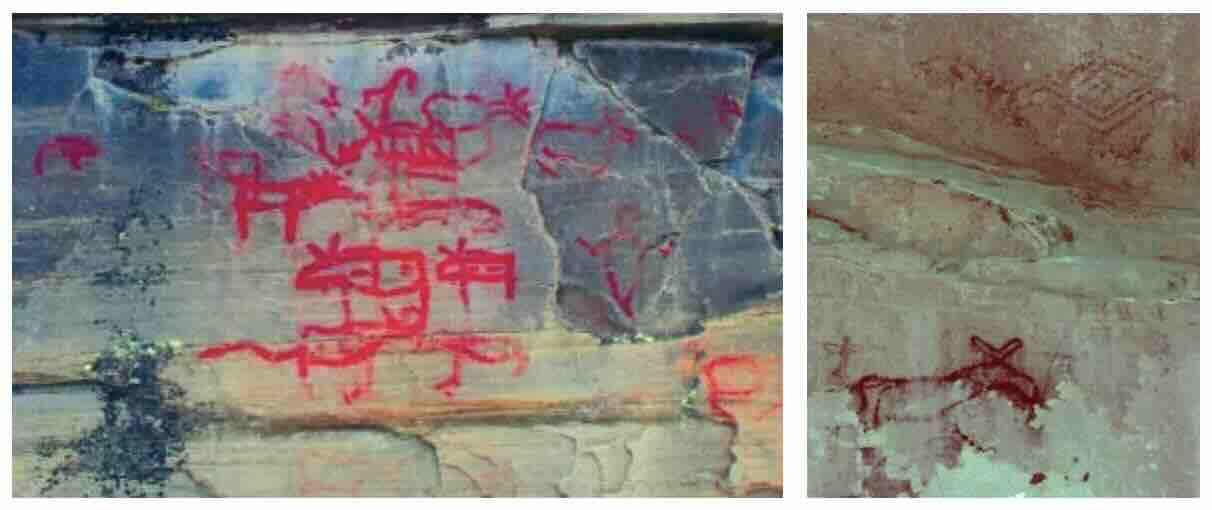
Early in his career, before Innrisser taught him to engrave, Omrisser painted rock panels at dozens of sites in northern Sweden. He also painted at a few sites in Norway. He painted with red ocher pigment, probably mixed with fat that penetrates the rock surface, leaving red traces that are still visible after more than a thousand years. (If there are oil stains on your kitchen's granite countertop, they may also last a thousand years :-) He must have worked during the winter or spring in Sweden, when he could stand on ice-covered lakes and paint rock panels at the lake edge. Later, he also stood on frozen lakes to make engravings. I suspect that he was born south of Stršmsund Sweden, where there is a cluster of rock paintings, all within skiing distance from each other. They are not far from NŠmforsen, where he and Innrisser worked together making nailpoint petroglyphs. Their engravings at NŠmforsen are quite similar and difficult to distinguish.
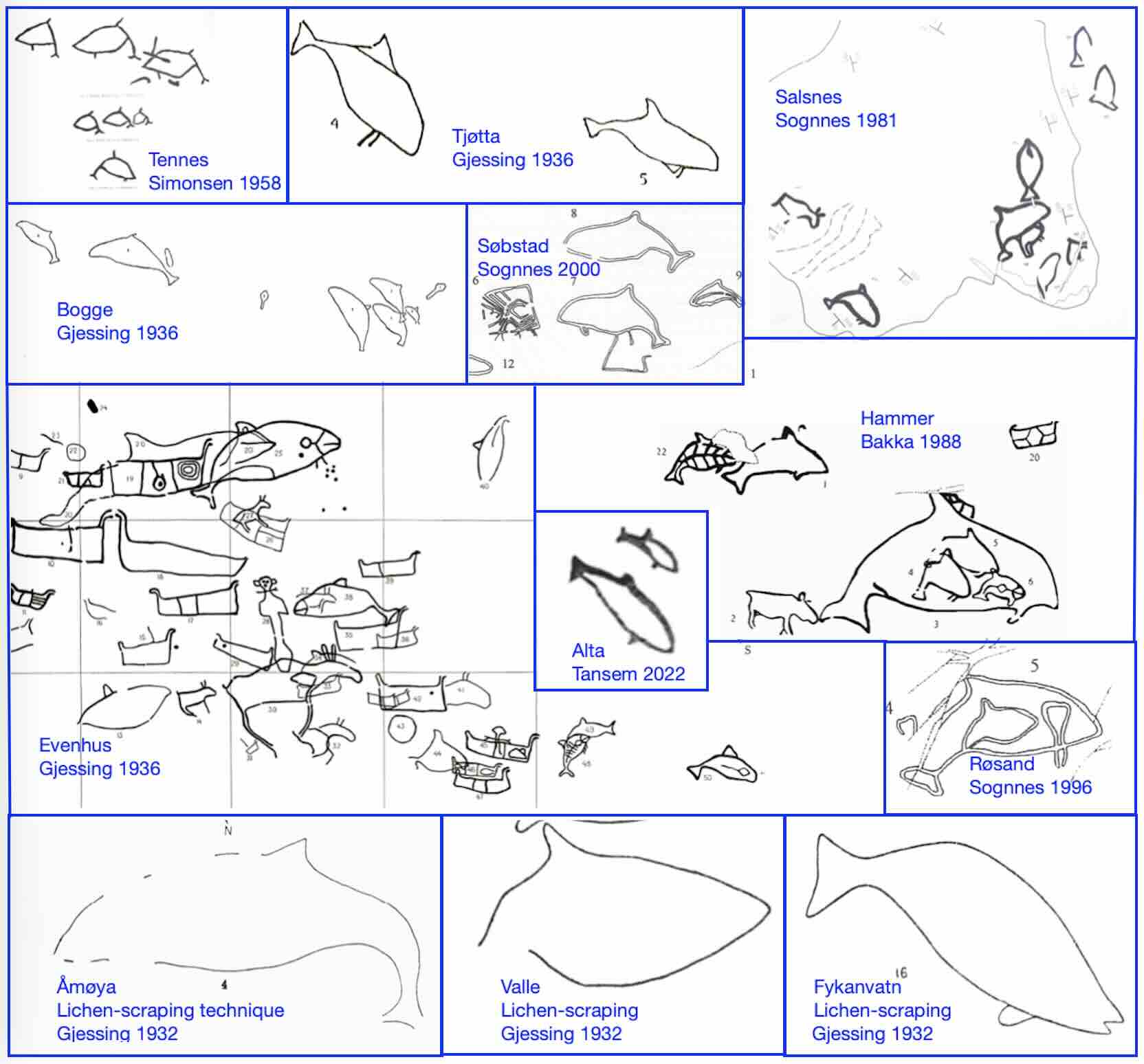
       Omrisser's earliest engravings may have been the crude ones at Tennes. We see this most clearly in the porpoises, a motif that he liked to draw. Some of his porpoises are shown below. Note the porpoises' tails typically point down. Also note that he used two short lines to indicate flippers on porpoises at Tj¿tta, Salsnes, Hammer, Tennes, and Amtmannsnes (Alta). Such quirks suggest the work of a single artist.

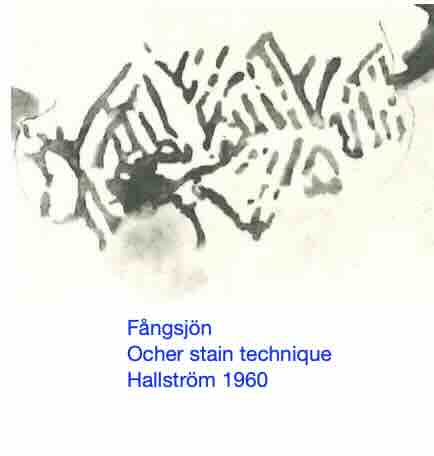
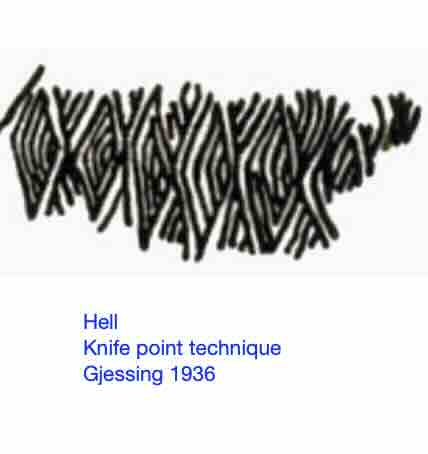
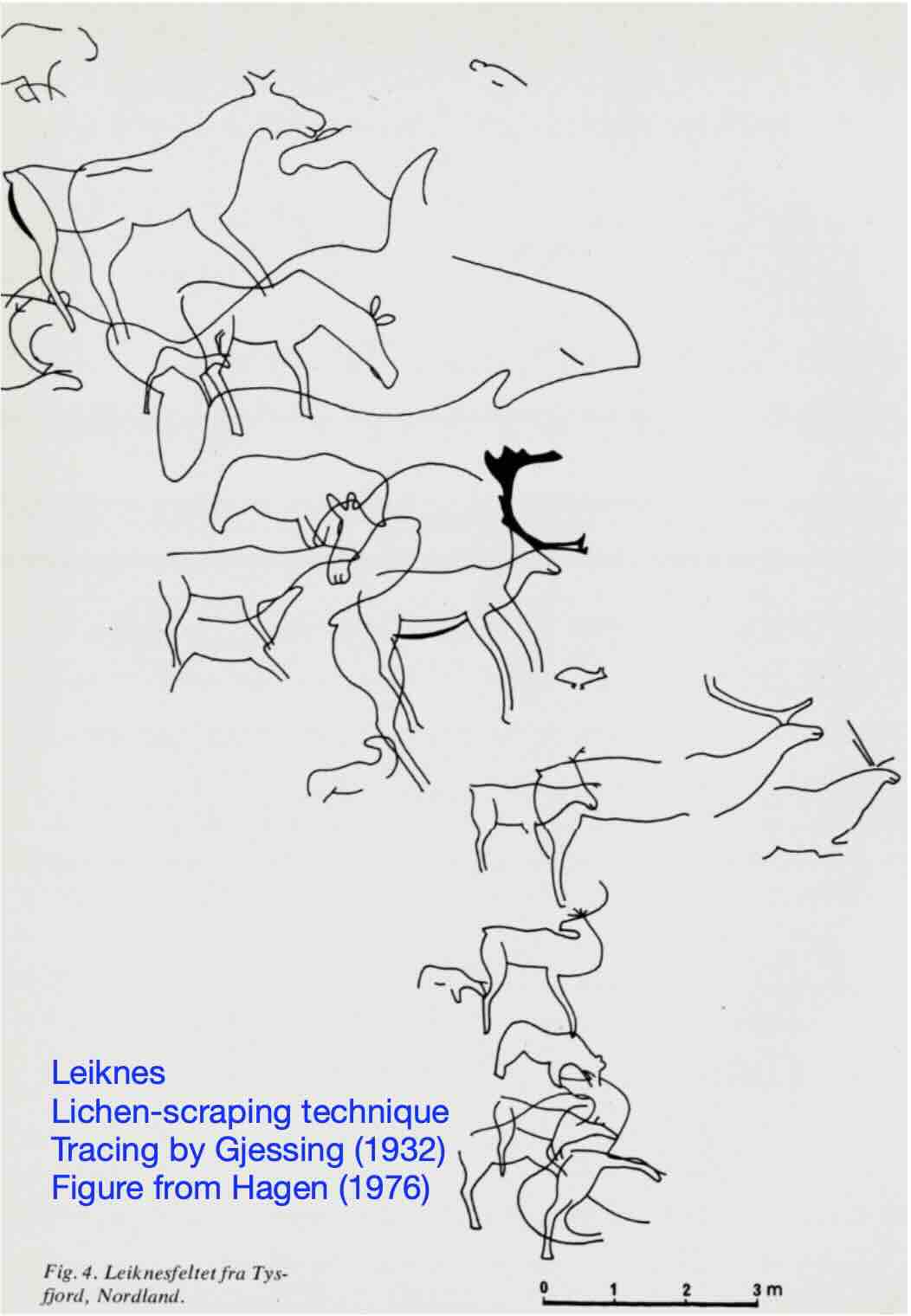
Omrisser used four different petroglyph techniques during his career. He started with red ocher stain, but mostly he used the nailpoint technique. On two panels of soft rocks (at GŠrde and Hell) he used the point of a knife. Late in his career, at the peak of his anatomical drawing skill, he discovered that he could quickly and easily make large petroglyphs by scraping away black lichen that covers the surfaces of glacially-polished white granites. Using that technique he made life-sized and lifelike images of animals at seven known sites in Nordland: Leiknes, Fykanvatn, Mj¿nes, Nes, Sagelva, Valle, and m¿ya.
       Omrisser made Scandinavia's largest images. His outlined orca whale at Leiknes (below left) is 7.5 meters long, and his outlined boat at m¿ya on one of Stikkmann's panels (below right) is 5.5 meters long.

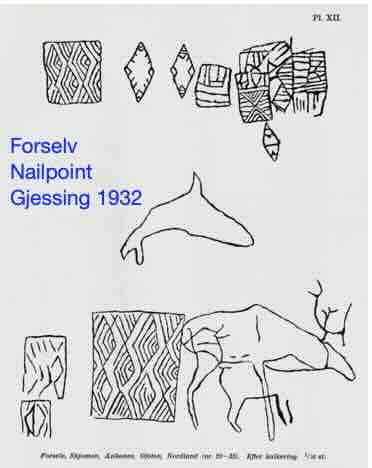
Omrisser 'signed' many of his panels with rhombic designs. The ones at FŒngsjšn (JŠmtland), Hell (Tr¿ndelag), and Forselv (Nordland) have a remarkable 3D-look.


Tryggvi Tagger.  In our 'Urban Age' we are familiar with street art Ñgraffiti and tagging. Petroglyphs were rock art graffiti, and Stikkmann, Innrisser, and Omrisser were Iron Age 'Banksys'. A fourth person, whom I call Tryggvi Tagger, made cup marks on boulders in high mountain areas of southern Norway. The photo below of Tagger's cup marks was published by Johannes B¿e (1932) and reproduced as Fig. 156 in The Rock Art of Norway by L¿d¿en & Mandt (2010).


Tagger's engravings were not artistic, but simply showed where he had been. I think he was inspired to make cup marks from seeing Stikkmann's engravings in Ullensvang on the east side of Hardangerfjord. Tagger made hundreds of cup marks on about 50 boulders near Stikkmann'a panel at B¿rve. From there he went north and northeast, tagging cup marks on over a hundred boulders over a huge area, as far away as 150 km from Ullensvang. Tagger and Stikkmann made lots of cup marks, but Innrisser and Omrisser never made any.


Runestones were engraved by other artists, who probably used iron chisels with steel edges, like the best Viking swords. There are about 10 runestones in Norway and Sweden with Elder Futhark runes (24 character alphabet). I know of none that include images. There are over 2000 runestones with Futhark runes (16 character alphabet) from the Viking age, 800-1030 CE. Many of these runestones have images, but none resemble the images of Stikkmann, Innrisser, or Omrisser. None have cup marks.

Petroglyphs cannot be dated directly, and that has been a problem, because people expect archaeologists to tell just how old an artifact is. Norwegian archaeologists adopted the 'shoreline dating method' a century ago. Shoreline dating gives the time that the land area rose above the sea during post-glacial uplift. That is the oldest possible time of human activity on that land. It is a geological age, not an archaeological age. It only works if the petroglyphs were made right at the shoreline. But I think they would not have been made there. My geology students and I cannot work with slippery shoreline rocks.
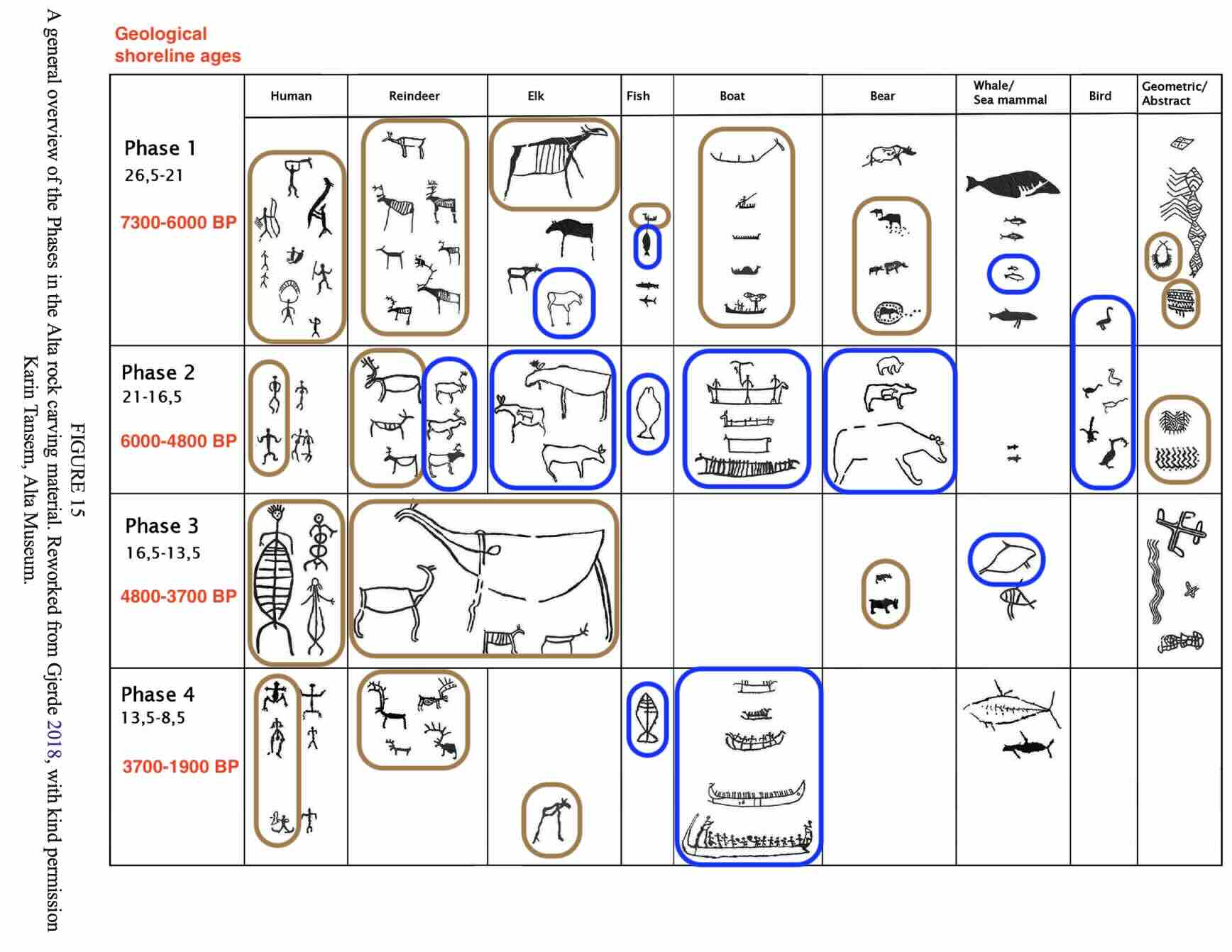
       At many petroglyph sites, images high on a hillside are said to be hundreds of years older than similar images a few meters lower down. At Alta, the age difference is said to be over 5000 years. The figure below, from a publication by Jan Magne Gjerde (2024) shows the four supposed phases of rock art at Alta that were established in a publication by Knut Helskog (1988). I have added in red the years BP (Before Present) that are claimed for those phases. The ages apply only to the ancient shore levels, not the images. I ignore the elevations of Alta images, and can identify most of them as the work of either Innrisser (brown) or Omrisser (blue).
I think that the positions of images on a rock panel have no chronological significance, other than within a single day's work. Petroglyph artists probably tended to move upward on a hillside as they worked, as geologists usually do. Look again at the lichen-scraped images at Leiknes, with the 7.5-meter orca whale. Modern vandalism shows that such images can be made in only a few minutes. I suppose that Omrisser produced them all in a single day, working from the lowest image to the highest. In contrast, Gjerde (2010) suggested that the lower images were drawn at a shoreline several hundred years after the upper images were drawn at a higher shoreline. Those shorelines are about 8,000 years old.

Successful falsifications and misinterpretations.  Shoreline dating and the belief that people inhabited the Norwegian coast as early as 10,000 years ago were initiated by Anders Nummedal. He was a school teacher with an education in geology. He knew the ages of uplifted beach terraces and he knew how to chip rocks. I contend that from 1909 to 1939 he made stone implements himself, and then said he found them on beach terraces. He went straight to the newspapers with his exciting claims. Archaeologists were doubtful that his artifacts were from the early Stone Age, but benefitted from that belief.
       There are no lichens or rust stains on the chipped surfaces of Nummedal's artifacts. That tells me that they were freshly made, not 'found' on the surface where lichen would grow, or beneath the surface where stains would occur. Nummedal's goal was to create a belief in Stone Age inhabitants (his 'Komsa and Fosna Cultures'), and to create an archaeology career for himself. In 1917, at the age of 50, the Norwegian government granted him a lifetime salary (statstipend) to find artifacts. I am certain that he falsified finds on uplifted beaches at over 200 sites in central Norway and at his 61 numbered sites in Finnmark. He wrote that he easily found artifacts, they 'jump easily enough into the eyes' (springer lett nok i ¿inene) and that it was his fate to discover Norway's prehistoric settlements. Archaeologist Johannes B¿e, his coauthor, noticed that many of Nummedal's artifacts in Finnmark were chipped from rounded beach cobbles of poor quality stone. There was no evidence of quarrying or transport of high quality materials. I think the chipping of the artifacts looks amateurish and the tools unusable.
       Archaeologists were fooled by Nummedal's deceit for many years. Then some must have realized that he was a fraud, but could not mention it. Archaeology needs to maintain and boost its own reputation. The funding is dependent on it. Archaeologists stopped including references to Nummedal's pioneering publications in their own works, and stopped encouraging students to read his reports. I have translated Nummedal's fraudulent book Le Finnmarkien: Les origines de la civilisation dans l'extrme-nord de l'Europe and delved into archaeological hoaxes (see Hoaxyz.com). My goal in doing that is to wake people up to the existence of falsifications. Cheating and cover-ups can occur in archaeology, just as they occur in sports, governments, religions, and other professions. It is naive to be unwary. It should always be kept in mind that it is easy to falsify a one-time find where there are no impartial witnesses.
       I hypothesize that there were no permanent inhabitants in Norway in the Stone Age. There is no source of flint in Norway. Archaeologists write that flint was carried to Norway by floating icebergs (see Norsk Arkeologisk Leksikon, p. 112). As a geologist, I know that ice could not have carried flint to Norway. Most of the supposed Stone Age flint was probably brought in Viking times as ballast in longships. A typical longship from Denmark would bring hundreds of kilos of flint ballast, which would be dumped on the Norwegian beach so the boat could be dragged ashore. Viking-age flint can still be found today, and was probably used by Nummedal. If there were Stone Age inhabitants in Norway, there would be datable organic materials, such as buried human bones, carved antler, bone, and wood. Archaeologists say that these materials have decayed away. But geologists find such old materials. Archaeologists do too: they sometimes date bits of charcoal and shells that they say were left by humans. I contend they are dating natural beach deposits. They are geologic, not archaeologic dates.

Three artists Ñwhy did they do it?   Ingi InnrisserÕs and Oddr OmrisserÕs petroglyphs have been called veideristninger, or hunting engravings. Steinn StikkmannÕs petroglyphs have been called jordbruksristninger, or farming engravings. Actually, there are very few depictions of hunting or farming. The images have been thought to reflect cults and rituals in the distant past. Now we can imagine other motivations artists might have had for making the engravings.
       Innrisser and Omrisser were interested in animals, but not hunting. They were both fascinated by domesticated reindeer. Innrisser showed reindeer corrals, and Omrisser showed reindeer with collars. Stikkmann was mostly interested in ships in Scandinavia, but not in Italy.
       Stikkmann liked the physical process of engraving, and was a bit compulsive. We can see that, because he engraved the same image so many times: examples are his 70 horses at Fordal (Stj¿rdal), 400 shoe prints at Leirfall (Stj¿rdal), and 1000 cup marks at Stenbacken (Tanum). At Aspeberget (Tanum) he drew a vertical column of 15 boats, all the same. At Valcamonica he drew no boats, but drew vertical columns of the same image (at Cemmo): a deer, a horse, an ox, a plowing scene, and a dagger. Engraving the same image again and again was a mindless activity that he enjoyed. And, like Tryggvi Tagger, Stikkmann engraved cup marks to leave his personal mark at places he visited.
       Stikkmann drew some dramatic scenes in BohuslŠn and Valcamonica, such as deer being chased by dogs, and two men dueling. He drew many men with penises, but I think they do not indicate a fertility cult. He almost never drew a woman or a child. He probably drew the penis to indicate masculine gender. He put penises on horses, bulls, dogs, and deer. Some of Stikkmann's men have exaggerated phalluses and brandish weapons, which seems to indicate they were men of power. Penis images were probably not a big deal in Scandinavia in the Iron Age: Innrisser and Omrisser sometimes drew penises, and so did a petroglyph artist at Kanozero and Vyg in Russia. But Stikkmann was especially interested in them.
       Innrisser also enjoyed the engraving process. Omrisser, on the other hand, was fond of drawing, but not engraving. He typically did not complete his engravings. For his large life-like animals, such as the 6-meter long whale at Bardal, he must have drawn them, to get the proportions correct, but didn't bother to completely engrave them.
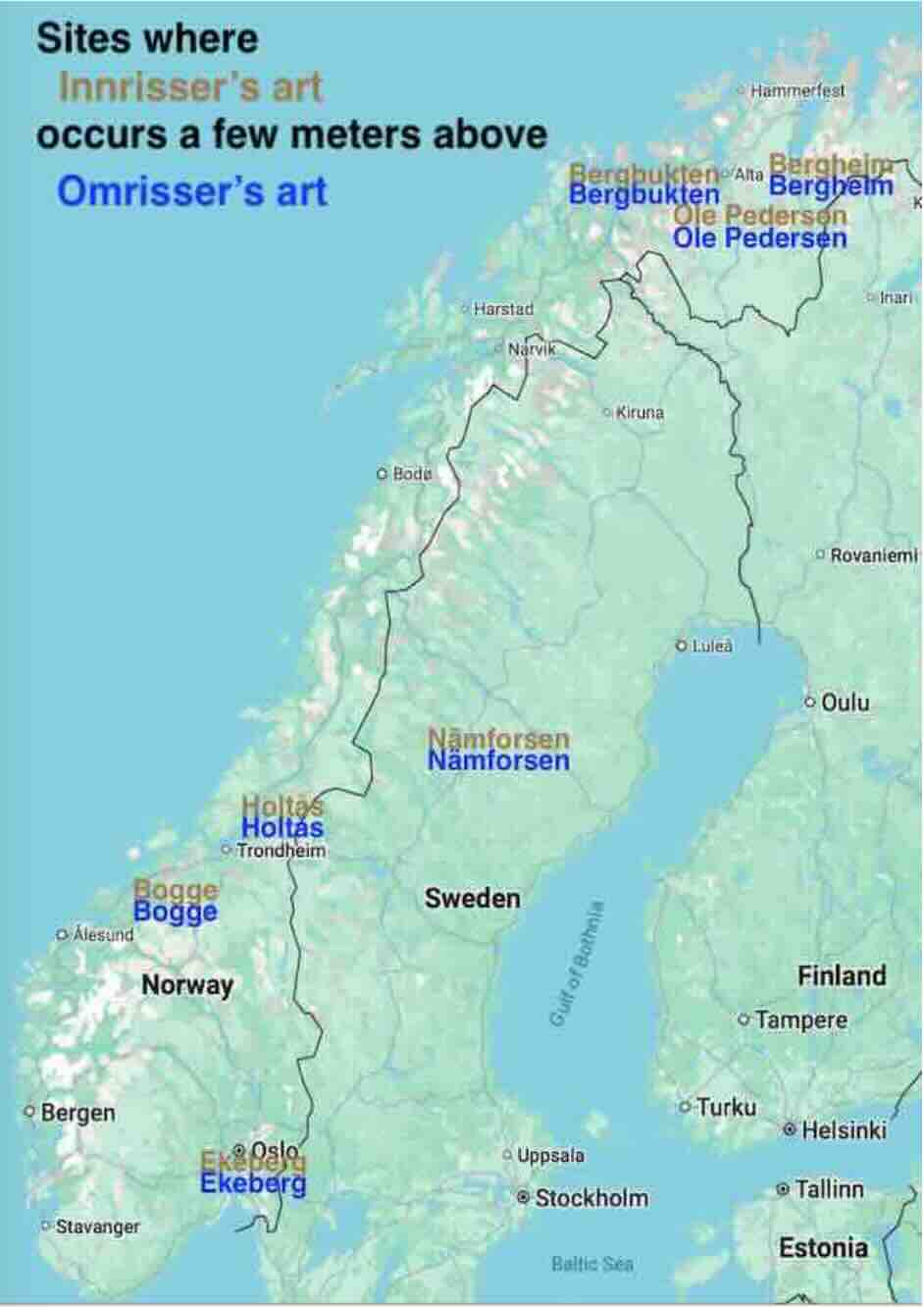
       Omrisser liked working together with Innrisser. But Innrisser was sometimes annoyed at Omrisser for defacing his panels. When Innrisser chased Omrisser away, he often went down the hill. I think that was so he could look up at Innrisser while working. If he went up the hill to work, he would need to stop working and turn around to look at Innrisser. Omrisser's art is below Innrisser's art on many hillsides: at EkebergBoggeHoltŒs, and NŠmforsen, and in Alta at BergbuktenOle Pedersen, and Bergheim. Omrisser liked working with Innrisser, but I'm not sure the feeling was mutual.


Stikkmann, Innrisser, and Omrisser were artists. Stikkmann was also a tagger. His figures sometimes tell stories, but the scenes are difficult to interpret. Innrisser was also a storyteller, documenting human and animal activities. Omrisser was a naturalist, trying to make good likenesses of many types of animals. We can imagine that the three artists also drew on other materials that have not survived.

Archaeologists are stuck with the paradigm that they inherited Ñthat rock art was made at significant places by local cultures over hundreds of years. Archaeologists and other professionals have training and expertise that are suited to an established paradigm. They cannot discuss or adopt an alternative paradigm. I know this from research for my book Not Getting the Drift about the paradigm shift from fixed continents to plate tectonics in geology. A more familiar example might be American football players and teams who now know about CTE brain disease, but their training and expertise are in football, and they cannot shift to basketball or some other sport. Another example is Jesuit priests, who are often excellent scientific researchers, but must work with science deniers. If one of them publicly disputed dogma such as the bodily ascension of Jesus, he would be shunned by his colleagues, and would lose his research funding.
       No one likes a heterodoc telling people that their beliefs are incorrect. Archaeologists have not answered my email queries and they have not come to my lectures. Journal editors have refused to send my manuscripts to peer review. That is all to be expected. But as a professor, I want to document my research and educate students. I want them to be aware that experts can make mistakes, and sometimes must cover them up. I document my work here at Helleristninger.com, and at Groups.io, a discussion web site where anyone can contribute. You may comment and share your own hypotheses and evidence there.

Allan Krill
allankrill@gmail.com

PS: Differing mindsets in geology and archaeology. Geologists and archaeologists interpret past events. One of the guidelines in geology is: ÒThe present is the key to the past.Ó  In contrast, a guideline in archaeology is: "Avoid presentism."  I do not follow that guideline. In my view, human behavior in the present must be the key to interpreting behavior in the past.
        Archaeologists often write that ancient petroglyphs and their meanings can never be fully understood. Archaeologists want to keep mysteries alive, because that increases public interest and funding. Geologists want to solve mysteries (or hide them), because unsolved mysteries decrease people's trust in their competence.
        As a geologist, I map the petroglyphs and artists in the way that geologists map rocks. A geologic mapper studies a rockÕs minerals and textures at a key site and invents a name for that rock. (For example the 'Jergul Gneiss', a name I invented in 1985.)  Rocks vary from place to place. If the rock at another site seems about the same, a mapper uses the same color on the map, and the same rock name. If the rock seems too different, another color and name are used. Geologists who focus on similarities and prefer few names are sometimes called 'lumpers', whereas those who focus on differences and prefer many names are 'splitters'. I am a lumper ÑI currently think that there were only three petroglyph artists. Archaeologists tend to be splitters.
       Below is a geologic map of Fennoscandia (Norden) from 1933. The rocks vary in age and appearance, and have been given various local names. Note the Bohus Granite ÑStikkmann's favorite rock. Note also that Denmark is completely covered by soft sedimentary rocks. That is why Stikkmann tagged boulders with cup marks.


Click on a site name to see some of the petroglyph images.
Almfjellet, Tr¿ndelag (Omrisser) [ocher technique]
Alta, Finnmark (Innrisser + Omrisser)
Alta Amtmannsnes, Finnmark (Innrisser)
Alta Apanes, Finnmark (Omrisser)
Alta Bergbukten, Finnmark (Innrisser shown in red)Ê(Omrisser shown in blue)
Alta KŒfjord, Finnmark (Innrisser shown in black)Ê(Omrisser shown in blue)
Alta Ole Pedersen, Finnmark (Innrisser + Omrisser)
Ausevik, Vestland (Innrisser)  
Bardal I, Tr¿ndelag (Omrisser, with Stikkmann's work not shown) 
Bardal II, Tr¿ndelag (Stikkmann + Omrisser) [39% cup marks, 21% shoe soles]
Bardal III, Tr¿ndelag (Innrisser)  
Bj¿rset, M¿re og Romsdal (Omrisser?)  
Bogge (Boggestranda) I, II, III, M¿re og Romsdal (Innrisser + Omrisser)
Bogge I, M¿re og Romsdal (InnrisserÊ+ Omrisser)  
Bogge II, M¿re og Romsdal (Omrisser)  
Bogge III, M¿re og Romsdal (Omrisser)  
Brennholtet, Nordland (Omrisser)  
B¿la, Tr¿ndelag (Omrisser)
Dokkfl¿yvatnet, Innlandet (Innrisser? + Omrisser?)
Drotten, Innlandet (Innrisser + Omrisser)
Duved (resjšn), JŠmtland (Omrisser)
Eidefossen, Innlandet (Omrisser)
Ekeberg (Sj¿mannsskolen), Oslo (Innrisser + Omrisser)
Flatruet, JŠmtland (Omrisser) [ocher technique] 
Forselv (Skjomen), Nordland (Omrisser) [3D rhombic 'signature']
ForsŒ (Efjord), nordland (Omrisser)
Fykanvatn, Nordland (Omrisser) [lichen-scraping technique] 
FŒngsjšn, JŠmtland (Omrisser) [ocher technique]  [3D rhombic 'signature']
Gamnes, Finnmark (Innrisser)  
Geithus, Buskerud (Innrisser + Omrisser)
Glemmestad, Innlandet (Innrisser + Omrisser)
Glšsa, JŠmtland (Innrisser)  
GŠrde, JŠmtland (Omrisser) [knife-point technique] 
GŒshopen, Finnmark (Innrisser)
Hammer I, IV, V, VI, VIII, X, XIII, XIV, XV, Tr¿ndelag Ê(Omrisser)  
Hammer IX, Tr¿ndelag Ê(Stikkmann + Omrisser)  
Hell, Tr¿ndelag +page, (Omrisser) [knife-point technique] [3D rhombic 'signature'] 
Herjangen, Nordland (Omrisser)
Hinna (Honhammer, Tingvoll), M¿re og Romsdal (Omrisser) [ocher technique] 
HoltŒs I, Tr¿ndelag (Innrisser)  
HoltŒs I, II, Tr¿ndelag (Omrisser)  
Hommelvik I, II (Steinaldervegen), Tr¿ndelag (Omrisser)  
Honnhammerneset (Tingvoll), M¿re og Romsdal (Omrisser) [ocher technique]
Horjem, Tr¿ndelag (Omrisser)
HŠstskotjŠrn, JŠmtland (Omrisser) [ocher technique]
Isnestoften (Langnesholmen), FinnmarkÊ (InnrisserÊ+ Omrisser)
Kvennavika, Tr¿ndelag (Omrisser)  
Landverk (nnsjšn), JŠmtland (Omrisser)  
Langnesholmen (Isnestoften), Finnmark (InnrisserÊ+ Omrisser)  
Leiknes, Nordland (Omrisser) [lichen-scraping technique] 
Leirbukt, Finnmark (Innrisser)  
Lier (Utenga), Buskerud (Innrisser + Omrisser)
LŒnke (T¿nsŒsen), Tr¿ndelag (Omrisser)  
Mj¿nes (VŒgan), Nordland (Omrisser) [lichen-scraping technique] 
M¿llerstufossen, Innlandet (Innrisser)  
Nes (Josarsaklubben, L¿dingen), Nordland (Omrisser) [lichen-scraping technique]
Norrfors, Norrland  +page (Omrisser)
Nytj¿nna, Tr¿ndelag (Innrisser)  
NŠmforsen, VŠsternorrlands lŠn (Innrisser + Omrisser)  
Rauhammer, Tr¿ndelag (Omrisser) [ocher technique]
Reitaneset, M¿re og Romsdal (Innrisser?)
Rykkje (Kvam), Vestland (Omrisser)  
R¿sand, M¿re og Romsdal (Omrisser)  
Sagelva (T¿mmerneset), Nordland (Omrisser) [lichen-scraping technique] 
Salsnes (Reppen), Tr¿ndelag (Omrisser)  
Salthammeren (Vangdal), Vestland (InnrisserÊ+ Omrisser)  
Salthammeren (Vangdal) upper panel, Vestland (Omrisser)Ê  
Sandhalsen, Tr¿ndelag (Omrisser) [ocher technique]
Sj¿hagen-Meling (m¿y), Rogaland (Stikkmann + Omrisser)  
Skavberget 1,2, Troms (Omrisser)  
Skavberget 3, Troms (InnrisserÊ+ Omrisser)  
Skogerveien, Buskerud +page (Innrisser)  
Slettjord, Nordland (Omrisser)  
Slettnes, Finnmark (Innrisser)  
Steinsodden (Stein, Steinsholmen), Innlandet (Innrisser) (+Omrisser)  
Storsteinen Alta, Finnmark (Innrisser)Ê(+Omrisser)  
Strand, Tr¿ndelag (Omrisser)  
Stykket, Tr¿ndelag (Omrisser)  
Surnadal, M¿re og Romsdal (Innrisser)
S¿bstad, M¿re og Romsdal (Omrisser)  
Tennes (Bukkhammaren), Troms (Innrisser
Tennes (GrŒberget), Troms (Innrisser + Omrisser)
Tennes (Kirkely), Troms (Innrisser + Omrisser)
Tj¿tta (Valen, R¿d¿ya, R¿¿yen), Nordland (Omrisser)  
Valle (FinnhŒgen, Efjord), Nordland +page +page (Omrisser)  
Vangdal (Salthammeren), Vestland (InnrisserÊ+ Omrisser)
Verdal, Tr¿ndelag (Omrisser)  
Vik on Rolla, Troms (Omrisser)
Vingen, Vestland (Innrisser)  
Vistnesdalen (Vistnes, Vevelstad), Nordland +page (Omrisser)  
bodsjšn, ngermanland (Omrisser) [ocher technique] 
m¿y, RogalandÊ(Stikkmann + Omrisser)  
m¿ya (Klubba), Nordland +page (Omrisser) [lichen-scraping technique]  
skollen, Buskerud (Innrisser)

Internet resources.
Kulturminnes¿k, Norway.
The Megalithic Portal.
Swedish Rock Art Research Archives.
Swedish Rune Map.

Multi-site descriptions. (More references).
Engelstad, Eivind, 1934. ¯stnorske ristninger og malinger av den arktiske gruppe.
Gjerde, Jan Magne, 2010. Rock art and landscapes. Studies of Stone Age rock art from Northern Fennoscandia.
Gjessing, Gutorm, 1932. Arktiske helleristninger i Nord-Norge.
Gjessing, Gutorm, 1936. Nordenfjelske ristninger og malinger av den arktiske gruppe.
Hagen, Anders, 1965. Rock Carvings in Norway.
Hagen, Anders, 1976. Bergkunst: Jegerfolkets helleristninger og malninger i norsk steinalder.
Hagen, Anders, 1990. Helleristningar i Noreg.
Helberg, Bj¿rn Hebba, 2016. Bergkunst nord for Polarsirkelen.
Helskog, Knut, 1988. Helleristningene i Alta.
Mandt, Gro & Trond L¿d¿en, 2005. Bergkunst. Helleristningar i Noreg.
Mandt, Gro & Trond L¿d¿en, 2010. The Rock Art of Norway.
Mandt Larsen, Gro, 1972. Bergbilder i Hordaland.
Marstrander, Sverre & Kalle Sognnes, 1999. Tr¿ndelags jordbruksristninger.
Mikkelsen, Egil, 1977. ¯stnorske veideristninger: Kronologi og ¿ko-kulturelt milj¿.
Moe, Steinar & Einar ¯stmo, 1994. Norske helleristninger.
Simonsen, Povl, 1958. Arktiske helleristninger i Nord-Norge II.
Sognnes, Kalle, 1999. Det levende berget.
Sognnes, Kalle, 1999. Helleristninger i Stj¿rdal.
Tansem, Karin, 2022. Helleristningene i Alta: Estetikken, geologien og figurene.

The links below explain my evidence and hypotheses (including hypotheses that I have abandoned).
   Index of the website https://groups.io/g/VikingRockArt
 

378. Steinn Stikkmann drew Norwegian-style lofts in Valcamonica  (2/2026)

377. Paddles became Stikkmann's favorite doodle image in Valcamonica  (2/2026)

376. Do Valcamonica petroglyphs really depict village life in the Alps?  (2/2026)

375. Steinn Stikkmann reworked his Swedish hunting-motif many times in Italy (2/2026)

374. These geology students are not praying (2/2026)

372. Distinctive birds migrated with Steinn Stikkmann from Sweden to Italy (2/2026)

361/370/373. Similar plowing scenes at Tanum and Valcamonica (2/2026)

369. StikkmannÕs images at Aspeberget (Tanum) and Cemmo (Valcamonica) (2/2026)

368. StikkmannÕs route from the Ligurian Sea to the Western Alps and the Eastern Alps (2/2026)

367. Steinn Stikkmann's horse-and-chariot motif in Aussois, Western Alps (2/2026)

365. Longship voyages by Scandinavian petroglyph artists (2/2026)

364. Two types of Camunian roses: Camunian swastikas and Camunian Xs (2/2026)

362. 1294 shoe-prints and footprints have been found in Valcamonica (2/2026)

360. Man standing on a horse at Valcamonica and Tanum (2/2026)

359. Dueling men as a motif at Tanum and Valcamonica (2/2026)

358. Find 22 birds at Tanum (2/2026)

357. Exposed men with spears at Tanum and Valcamonica (2/2026)

355. Steinn StikkmannÕs deer at BohuslŠn (Sweden) and at Valcamonica (Italy) (2/2026)

354. 10,000-years of petroglyphs in Valcamonica is simply wishful thinking (2/2026)

353. StikkmannÕs 'Camunian roses' in BohuslŠn Sweden and Valcamonica Italy (2/2026)

352. Steinn StikkmannÕs made thousands of petroglyphs in Valcamonica, Italy (1/2026)

350. Map of Steinn StikkmannÕs cup marks and petroglyphs in Sweden (1/2026)

348. Gutorm Gjessing fooled the ski-world for 90 years (1/2026)

345. Steinn StikkmannÕs men with calf-muscles and no biceps (1/2026)

343. Stikkmann's slimline horses in Norway (1/2026)

342. January 2026 status report for Helleristninger.com (1/2026)

340. Re: Distinctive images: 2-wheeled cart pulled by 2 thin horses, by Steinn Stikkmann  (1/2026)

337. InnrisserÕs story elements at Ole Pedersen, Bergheim, Bergbukten, and KŒfjord in Alta (12/2025)

335/338. Guide to helleristninger at Apana GŒrd, Alta (12/2025)

333/336. Guide to helleristninger at Bergheim, Alta (12/2025)

332. Guide to helleristninger at Ole Pedersen, Alta (12/2025)

328/329/330. Can you find Omrisser's reindeer within Innrisser's herd? (11-12/2025)

327. Omrisser and Innrisser at the five main sites of Hjemmeluft, Alta (11/2025)

323/326. Guide to helleristninger at Bergbukten Alta (11/2025)

321/325. Guide to NŠmforsen hŠllristningar  (11/2025)

324. Guide to helleristninger at Bogge (11/2025)

322. Guide to helleristninger at Sj¿mannskolen (Ekeberg) Oslo (11/2025)

316/319. Who made which engravings at NŠmforsen?  (11/2025)

261/320. InnrisserÕs powerful animal-head sticks (Alta, Vingen, and NŠmforsen)  (11/2025)

312. Steinn Stikkmann visited only one island in BohuslŠn (Orust)  (10/2025)

311. Stikkmann liked the looks of Bronze Age axes (but drew them in the Iron Age)  (10/2025)

310/313. Why are there no petroglyphs on the islands in the Tanum-Kville area?  (10/2025)

309/315. Steinn Stikkmann's sites in Denmark  (10/2025)

308. Sagaholm and Bredaršr are Bronze Age monuments, decorated by Stikkmann in about 400 AD  

307. Brandskogsskeppet may have been an engraved copy of another artistÕs drawing  (9/2025)

293/296/306. Steinn Stikkmann's sites in eastern and southern Sweden  (5/2025)

305. Steinn Stikkmann wanted his art to be seen and appreciated  (9/2025)

304. List of references for Scandinavian rock art  (9/2025)

303. Archaeologists have never found chips from supposed stone pecking tools  (6/2025)

302. Steinn Stikkmann visited Tj¿tta, north NorwayÕs main pre-Viking settlement  (6/2025)

301. Steinn Stikkmann left boats, cup marks, and runes on Ytter¿ya  (6/2025)

300. Map of Steinn Stikkmann's travels  (6/2025)

298/299. Fluky site locations: Absence of evidence is evidence of absence  (5/2025)

297. I now know of runes at six of Steinn StikkmannÕs petroglyph sites  (5/2025)

294. Differing mindsets in geology and archaeology  (5/2025)

290. Rennebu and Gravem petroglyphs show that Stikkmann began his long journey on foot  

289. Steinn Stikkmann left his mark on the island Bornholm  (4/2025)

287. "Same ship, different day"  (4/2025)

286. Mostly cup marks on Orust, because there is no Bohus Granite there  (4/2025)

285. Percentages of StikkmannÕs figures at sites in BohuslŠn, and at Lista, Leirfall, & Foss  

284. Steinn Stikkmann made a U-turn at the southern tip of Norway  (4/2025)

283. Only three traveling artists (not four)  (4/2025)

282. Steinn Stikkmann loved engraving cup marks  (4/2025)

281. Sites in BohuslŠn with swastikas and Elder Futhark runes by Steinn Stikkmann  (4/2025)

279. The maypole (majstŒngen) of Tanum was probably not engraved by Steinn Stikkmann  

278. StikkmannÕs art at Kivik is from about 400 CE, but the monument is probably older

277. Tryggvi Tagger probably learned nailpoint technique from Stikkmann at B¿rve

276. Innrisser and Omrisser were together at Glemmestad (2/2025)

275. StikkmannÕs phalluses were about masculinity and power, not fertility  (2/2025)

274. Innrisser and Omrisser were together at Ekeberg, Oslo (2/2025)

273. Innrisser and Omrisser were together at Salthammeren, Hardangerfjord  (2/2025)

272. Petroglyph sites record StikkmannÕs journey from Bergen to Stavanger to Telemark

271. Four traveling graffiti artists and one traveling graffiti tagger (2/2025)

270. Petroglyph sites show how Stikkmann traveled from Skien to the Bohus Granite  (4/2025)

269. At Bardal, InnrisserÕs deer got humps and bigger heads (2/2025)

268. How Innrisser's deer (finally) got their humps (2/2025)

267. At Selbustrand, I imagine Stikkmann thinking: 'These boulders are like from heaven!'

264. Innrisser and Omrisser were together on the island Langnesholmen in Altafjorden

263. Ingi InnrisserÕs early styles of drawing humans at Vingen, Storsteinen, and Amtmannsnes

262. Ingi InnrisserÕs birthplace was probably Skatestraumen near Vingen (1/2025)

261. InnrisserÕs powerful animal-head sticks (Alta, Vingen, and NŠmforsen) (1/2025)

258. Oddr OmrisserÕs birthplace was probably between Stršmsund and NŠmforsen, Sweden

257/259. Porpoise images show that Omrisser visited Tennes early in his career (1/2025)

256. StikkmannÕs birthplace was probably Foss in Gauldalen, central Norway (1/2025)

  ResearchGate PDF with links to 220 petroglyph sites (12/2024)

220/252. Elder Futhark runes (c. 400 AD) at Stuberg, Tessem, & KŒrstad, by Stikkmann

248/249/250. Stikkmann preferred Iddefjord (Bohus) Granite panels for his petroglyphs

247. Petroglyphs in Skien, tracings by Marstrander (1969) (12/2024)

246. Examples (2) of petroglyphs from the book 'HŠllristningar och Kultbruk'

245. Examples of petroglyphs from the book 'HŠllristningar och Kultbruk' by Almgren (1927)

244. Stikkmann's petroglyphs date the Kivik King's Grave to about 400 CE (12/2024)

242. Petroglyphs of supposed 'Bronze Age boats' are all from the Iron Age (12/2024)

241. Distinctive images: Another huge Stikkmann longship discovered this month (11/2024)

238. Ingi Innrisser could have made all the '¯stnorske veideristninger' in a single summer

237. Distinctive images: Outlines of bears, by Oddr Omrisser (11/2024)

236. Alphabetical list of petroglyph sites and artists (11/2024)

235. The rock art painting motifs in Finland are very different than those in northern Sweden

234. Ramqvist map shows limited motifs of ocher petroglyphs in northern Sweden (11/2024)

233. Map from Jamtli.com of all known ocher-paint petroglyph sites in northern Sweden

232. Ocher-paint petroglyphs in Mid-Norway (11/2024)

231. Distinctive images: Porpoises, by Oddr Omrisser (11/2024)

230/239. Omrisser made ocher paintings in Sweden in winter, standing on ice-covered lakes

226/227/228/229. Did Innrisser carve the 'Surnadal man' before or after the 'Ausevik men'?

225. Stikkmann traveled to ¯stfold-BohuslŠn via Sporaneset, missing Aust-Agder (11/2024)

224. Maps of BŒrdr BŒtmann's sites in Stavanger and SW Norway, from Fett & Fett (1941)

223. Oddr OmrisserÕs sites and works in Mid Norway and Sweden (11/2024)

222. Stikkmann, BŒtmann, Innrisser & Omrisser were 'pre-Viking Banksys'

221. Distinctive images: A big fish (by Omrisser) on top of petroglyphs at Alta and Stavanger

219. How could one artist produce petroglyphs at 2700 sites in the ¯stfold-BohuslŠn area?

216. Distinctive images: Deer looking back, by Oddr Omrisser (11/2024)

214/217. Distinctive images: A few 'giants' on a longship, by Steinn Stikkmann (11/2024)

213/215. Distinctive images: Complex scenes, by Ingi Innrisser (10/2024)

212/260. Distinctive images: Large, naturalistic animals, by Oddr Omrisser (10/2024)

211/340. Distinctive images: Chariot pulled by 2 thin horses, by Steinn Stikkmann (10/2024)

209. Distinctive images: Isolated deer head, by Oddr Omrisser (10/2024)

208. Distinctive images: Man approaching tiny woman from behind, by Oddr Omrisser

207. Distinctive images: Rhombs with 3D effect, by Oddr Omrisser (10/2024)

206/243. Distinctive images: Processions, by Steinn Stikkmann (10/2024)

204. Map of sites where 4 petroglyph artists worked, and 3 areas with no known petroglyphs

199. Petroglyphs tell about the 'Pre-Viking Age' in Scandinavia (10/2024)

198. Photos from B¿e (1932) show that a sharp point was used to peck Vingen petroglyphs

197. 'Omrisser' (Outliner) never visited Vingen (10/2024)

196. All the helleristninger at Vingen were made by one visiting artist: 'Innrisser'   (10/2024)

195. 'Inliner' may have used boat nails from Slettnes III at Slettnes IV  (5/2024)

194. Inliner's work now recognized on boulders at Slettnes  (5/2024)

193. Stickman (the first) and Outliner (the last) of the great petroglyph artists  (12/2023)

191. Lecture on Stickman and Outliner (20 figures)  (11/2023)

   (Video) Lecture on Stickman and Outliner (first 40 seconds in Norwegian)

190. Map of 90 petroglyph sites and typology used to identify 7 artists  (10/2023)

181. Red-ochre painting at Tingvoll and at FŒngsjšn: a fourth technique used by Outliner

178. Map of 90 sites where petroglyph artists worked, and 3 areas where none are known 

173. Stickman may have made all of the petroglyphs in the ¯stfold-BohuslŠn area  (8/2023)

172. Why are there no known petroglyph sites in Aust-Agder?  (8/2023)

171. Outliner's large humans at Alta, Bardal, B¿la, Evenhus, Forselv, and LŒnke  (8/2023)

170. Futhark runes and a swastika independently date the KŒrstad petroglyphs to 400 AD

165. KŒrstad petroglyphs (200-500 AD) show runes and Hjortspring-style boats  (7/2023)

163. Outliner learned to draw longships at Stavanger and then drew them at Alta

161. At Bogge, chasing after petroglyph artists (7/2023)

158. Longship and boat petroglyphs at Apana gŒrd Alta (7/2023)

155. Matching images at 9 and 23 meters above sea level at Alta (7/2023)

121/154. Lumpers and splitters: I am a lumper, whereas archaeologists have refused to lump

152. Who made the longships of Iron-Age-style at Apana, Alta? (7/2023)

148. Learn to recognize Outliner's boats (7/2023)

147. "...depictions comparable to the South Scandinavian Bronze Age and Iron Age boats"

146. Bergbukten 1 (Alta): two artworks for the price of one (7/2023)

141/145. Inliner's 'nailpoint' reindeer at Apana gŒrd (8-10 m. above present sea level) (7/2023)

144. The famous petroglyph 'Man on skis' was probably a man standing in a boat

143. Two 'owners' of reindeer at Bergbukten 4B Alta ('Inliner' and 'Outliner') (7/2023)

142. Animal-head sticks and animal-head boats in Alta petroglyphs (7/2023)

140/149/153. Map of six petroglyph artists and sites where they worked (3) (7/2023)

139. Amtmann Ñ another petroglyph artist that can be recognized at Alta (7/2023)

137/138. A few hours' work by Outliner at KŒfjord, Alta (2) (7/2023)

136/150. Outliner carved petroglyphs on top of previous artworks at Bogge, Bardal, Alta

133. Outliner's petroglyphs are easy to recognize, and found only in the north (2) (7/2023)

132. Stykket is an example of 'distressed' art by Outliner (7/2023)

131. Petroglyphs at Leiknes: rock art from one year, or from five hundred years? (2) (7/2023)

130. Petroglyphs at Alta that I ascribe to Outliner and Inliner (tracings in the book by Helskog)

128. Some petroglyph moose at Alta that I ascribe to Outliner and Inliner (7/2023)

126. Some petroglyphs in central Scandianvia that I ascribe to Outliner and Inliner (7/2023)

124. Outliner's petroglyphs are easy to recognize, and found only in the north  (7/2023)

123. Outliner drew 'bulging' eyes at Brennholtet and Leiknes, and unique mouth lines  (7/2023)

122. Iron longship nails were ideal for making 'nailpoint' petroglyphs  (7/2023)

120. Photos taken at Tennes (GrŒberget, Balsfjord) in northern Norway (6/2023)

118. Photos taken at Tennes (Kirkely, Balsfjord) in northern Norway (6/2023)

117. Photos taken at Tennes (Bukkhammaren, Balsfjord) in northern Norway (6/2023)

116. Petroglyphs at Leiknes: rock art from one year, or from five hundred years? (6/2023)

115. No petroglyphs or Viking artifacts have been found in Finland (6/2023)

114. Outliner's nailpoint art at the Ole Pedersen site, Hjemmeluft, Alta (6/2023)

113. Why my manuscripts were rejected by the journals ÔVikingÕ and ÔPrimitive Tider (6/2023)

112. Stickman's early showpiece at Leirfall is currently closed to the public (6/2023)

109. Outliner's elegant pose: deer looking backward (6/2023)

108. Close-up photos of Inliner's 'nailpoint art' at the Ole Pedersen site, Hjemmeluft, Alta

106. Map of five petroglyph artists and sites where they worked (6/2023)

103. Outliner 'scraped' his petroglyphs in Nordland (he did not 'polish' them) (6/2023)

102. Ismo Luukkonen shows petroglyphs of 83 Scandinavian sites for you to study at home

101. Outliner's reindeer and moose at Fykanvatnet, near Glomfjord (6/2023)

100. Outliner's scraped moose petroglyph at Mj¿nes (VŒgan) (6/2023)

99. Outliner's reindeer and man at B¿la, near Steinkjer (6/2023)

98. Outliner's 'design-signature' at Hell (near Stj¿rdal) and Forselv (near Narvik) (6/2023)

97. Inliner's 'nailpoint art' at KŒfjord, Alta (6/2023)

96. Outliner's 'nailpoint art' in a one-man show at Apanes, Alta (6/2023)

95. No petroglyphs are found in suitable rocks near the shorelines (why not?) (6/2023)

93. Map of three main petroglyph artists (6/2023)

92. It was typical of Outliner to ignore the feet (5/2023)

91. Alta - KŒfjord petroglyphs seem to show early S‡mi culture and early Viking culture

89. Distinguishing between Inliner's work and Outliner's work at Alta (5/2023)

87 & 88. Outliner drew collars on some of his reindeer (2) (5/2023)

86. A boat with a square sail (5/2023)

85. S‡mi people lived with domesticated reindeer also before Viking times (5/2023)

84. Stickman trained in soft sedimentary rocks in the Stj¿rdal area (5/2023)

82. Outliner used three different techniques to outline bodies and body parts (5/2023)

81. Three artists made nearly all the petroglyphs around Trondheimsfjorden (5/2023)

80. Runes and petroglyphs at Ystines / Ydstines near Stj¿rdal (5/2023)

79. Petroglyph artists probably spoke a Scandinavian language (5/2023)

78. Inliner probably traveled to Ekeberg (Oslo) by boat, not by foot (5/2023)

77. Artist's names are not set in stone (5/2023)

76. Digital caliper: a new tool for describing petroglyphs (5/2023)

75. A paradigm for Scandinavian petroglyphs (manuscript to journal Primitive Tider) (5/2023)

66. Shoe prints. Artists often learn or copy from others (2/2023)

64. Names of places where petroglyph artists exhibited their work (2/2023)

62. Five petroglyph artists recognized by their motifs and artistic styles (manus. in prep)

61. An alternative interpretation of some petroglyphs in Finnmark (manus. to journal Viking)

59. Boats with animal heads among petroglyphs at Peterborough Canada (1/2023)

56. Vikings visited many coasts and rivers in their longships (1/2023)

55. Petroglyphs in Peterborough Canada, probably made by a Viking artist (1/2023)

53. "Shoreline dates" are not really dates at all. Better to call them "Shore maximum ages" 

52. Hard rocks can't be engraved using stone-age tools. Most Scandinavian rocks are hard.

51. A simple explanation for petroglyph cup marks  (12/2022)

45-49. 'Iron-age Banksys': how widely did they spread their wall-art? (5)  (11/2022)

44. Most petroglyphs were made within sight and shouting distance of the shoreline  (11/2022)

43. Petroglyph shoreline dates should be referred to as Çshore-limiting datesÈ  (11/2022)

42. Lichen grows on all exposed rocks in Norway  (11/2022)

39. Shoreline dating improperly used to date Vyg whale hunting  (11/2022)

38. Petroglyph evidence for cultural exchange between Vikings and S‡mi  (11/2022)

36. NŠmforsen petroglyphs supposedly show a 4000-year spread of carvings  (7/2023)

34. Petroglyph artists (300-800 AD) were Scandinavian and did not visit Finland  (11/2022)

33. What does this strange petroglyph really show?  (11/2022)

32. Spoiler alert: my musings kill good stories and eliminate fun puzzles  (11/2022)

31. Arctic summer hunting trips, destination Alta  (11/2022)

30. The Gamnes petroglyph and knapped-flint site can be no older than 1700 years 

29. See how flint arrowheads are knapped (Youtube)  (11/2022)

27. Newly discovered petroglyphs at 26 m show shoreline-dating gives us falsely old ages

26. Grahame Clark (1975): The Earlier Stone Age Settlement of Scandinavia  (11/2022)

24. How 'shoreline dating' has been used for Alta petroglyphs  (11/2022)

21. A petroglyph of a longship with an animal-head prow nails its age  (11/2022)

20. Biases maximize the age and archaeological value of Leirfall petroglyphs  (11/2022)

19. The Professor's Old Claims  (12/2022)

17. A Viking-age neck ring (torc) brought to Alta and abandoned there  (11/2022)

16. Why Alta petroglyphs do not include women and children  (11/2022)

15. "Here's our stuff. Ready to use again this summer!"  (11/2022)

14. 30 rowers (15 pairs) in a longship in Alta  (11/2022)

13. Ships with an animal-head prow, manned by long-distance rowers  (10/2022)

12. The Kvalsund ship from 780 AD resembles an Alta petroglyph  (10/2022)

11. The Hjortspring boat (350 BCE) had a crew of 20 rowers. It was built without nails 

10. Alta petroglyph boats. Myth vs. reality  (10/2022)

9. Could Alta boats really have been made before iron nails were available?  (10/2022)

8. The words "Viking" and "Iron" are taboo in publications on Nordic petroglyphs 

7. L¿d¿en (2015) on the experimental production of petroglyph images using a stone tool

6. The petroglyph artist at Storsteinen had no "sketchbook", only one "page" to draw on

5. Deep narrow engravings could not have been made before metal chisels were available

4. BŒrd Amundsen's article on the Viking-like culture that is said to be over 3000 years old

3. Jan Magne Gjerde (2010) Rock art and landscapes  (10/2022)

2. Alta rock art is probably Viking rock art  (10/2022)

1. Boat petroglyphs at Alta, Norway (photos at Donsmaps.com)  (10/2022)


Allan Krill
allankrill@gmail.com